MAY 25
Standing on the aft deck of Ganany, I savor these suspended moments in time aboard our stratospheric boat, magically gliding across the perfect wave, pulled by our two swan wings along the Corsican shores—so wild and magnificent that one understands why these proud islanders love their country.We have just left Bastia, where after several mishaps due to weather conditions, we picked up Martin for the final leg to Toulon. It's always better to have an engineer on board!Despite everything, the end of the journey and the Italy Posidonia Connect mission is in the air. Nostalgia already! The divers have carefully stowed their tanks and underwater astronaut equipment and put on elegant white Race for Water polos to mark their attachment to our Foundation that brought us together aboard for these intense and charming moments.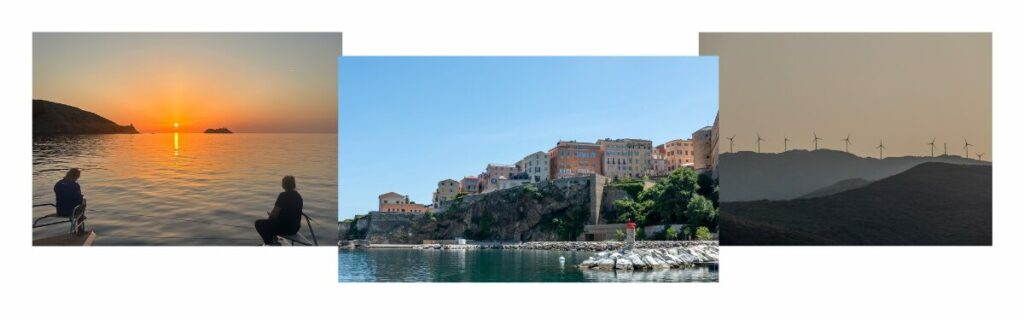
Now, all that remains is to negotiate the best possible path through the last traps of this unpredictable Mediterranean Sea—with "poteaunoiresque" white calms, minus the storms, which is fortunate. And arrive safely in Toulon for the final media operations organized by Lady Camille to close our mission, before storing our proud boat at the Saint Mandrier shipyard in preparation for upcoming summer sailings.What's the assessment? First, the Race for Water Foundation, Ocean Développement, and GIS Posidonie managed to bring together a Franco-Italian team that was not only high-performing but also friendly.Three weeks of navigation without major hitches, not a word raised above another, but plenty of laughter and smiles—a top-notch crew, from Captain Arnaud to steward-cook Marion, passing through laundry mate Caro Caroline! On their side, Plic and Ploc, aka Patrick and Bruno, our deep-sea Posidonia researcher-divers, assembled for our great pleasure a formidable squad of Italian scientists who quickly adapted to the sometimes strange customs of their blue-white-red partners. It would also be unfair to forget in this beautiful gathering Jean-Marc and Martin, our intermittent engineers, and of course Camille, my boss, organizer of the entirety of this scientific and media adventure who, among other things, had the good idea of inviting aboard for a few days little Marie, science communicator, intelligent influencer, and skillful drone pilot sometimes...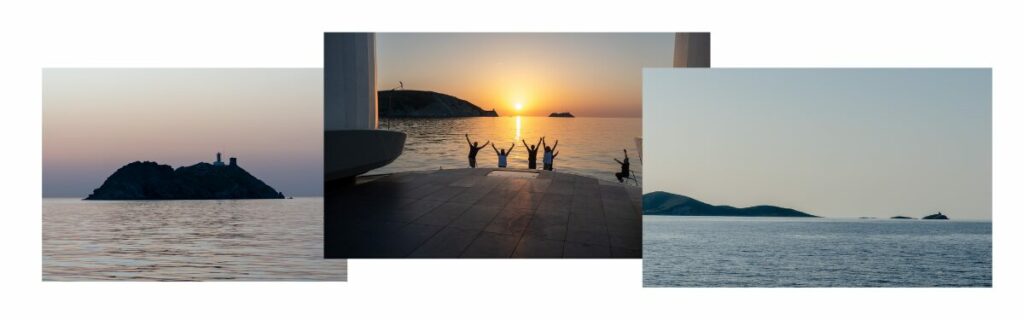
Despite uncooperative weather—too much wind during diving sessions and not enough during sailing, added to some administrative hassles due to certain incompetent, uncomprehending bureaucrats—our team of scientist-divers declares themselves satisfied with this exploration of the Italian, Sardinian, and Neapolitan coasts. That's the main thing! And this could herald future expeditions in other areas of the Mediterranean.
We also had the opportunity to let the public, recreational sailors, and visiting friends admire our futuristic and remarkable boat, on which we take so much pleasure living and sailing.
END OF THE POSIDONIA CONNECT ADVENTURE RACE FOR WATER
Almost a week after the end of this Italy mission of the Posidonia Connect project, I won't revisit our wonderful crew and their remarkable electric sailboat that gave us a superb Mediterranean journey. As an ambassador of the Foundation since 2014, I've had the chance to sail on several remarkable vessels—the MOD 70 trimaran, the solar catamaran, and now the MODX 70—with crews all equally competent and endearing. But this is the first time we've all left the boat with an intense feeling of melancholy in our hearts, all hoping to return together later for a new edition of this vital project alongside the GIS Posidonie team.
But the main thing remains our mission and its results. Having discussed this with Bruno and Patrick, this collaboration with our transalpine friends proved fruitful despite sometimes difficult weather and diplomatic conditions. The scientist-divers from the Università degli Studi di Sassari and the Stazione Zoologica Anton Dohrn integrated perfectly with the French team and together successfully explored ten major sites around northern Sardinia and the Bay of Naples. This sharing of knowledge and their various investigations helped prove the relevance of the new holistic indicator (the famous EBQI) that assesses the health of the seagrass plants and the entire ecosystem that goes with it.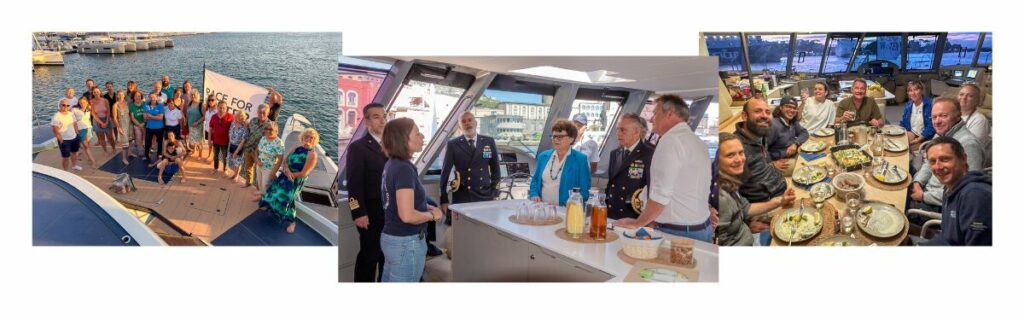
Nevertheless, our scientists' conclusions are rather mixed regarding the state of these seagrass beds. "Indeed," they lament, "despite protective measures taken by local institutions, despite the existence of MPAs (Marine Protected Areas), Posidonia is not doing well, still exposed to numerous aggressions, especially those from wild anchoring by boaters who are more ignorant than ill-intentioned." Solutions would include developing eco-friendly mooring areas, strengthening surveillance, but above all tackling the problem at its root and raising awareness among boaters by explaining the stakes of seagrass protection—in short, fighting ignorance.
From my perspective as a sailor engaged in this fight for ocean protection, I remain despairing of this lack of awareness—which had already struck me regarding the unknown dangers of plastics—due more to a lack of information than to a lack of interest. For this reason, I fully support the efforts and investments of our Foundation to try to educate adults and especially children. Thus, I greatly appreciated the visits of young people and older individuals on our extraordinary boat, passionate about the pedagogical wealth of the brilliant interventions by our scientists, the crew, and the partner educational associations Ocean Academy and La Fresque Océane of the mission.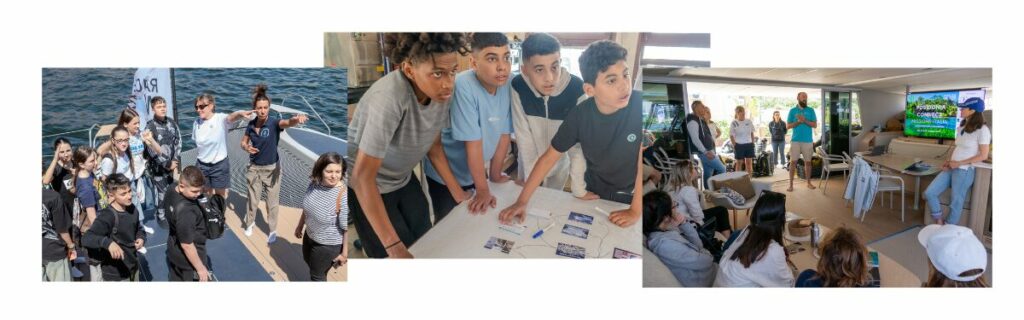
Furthermore, in parallel with these school visits aimed at directly involving younger generations, what a good initiative to have organized numerous meetings with local associative or governmental bodies to weave essential and strategic links for the future of our Posidonia Connect mission, which we all care deeply about.
To conclude, I obviously wish that we can continue our work in the coming years and this perfect collaboration with GIS Posidonie to continue fighting together for the protection and survival of the Mediterranean. I also wish that governments, public and private actors finally take an interest in the subject and can financially help the Foundation achieve its objectives until 2030, namely covering almost the entire Mediterranean basin.
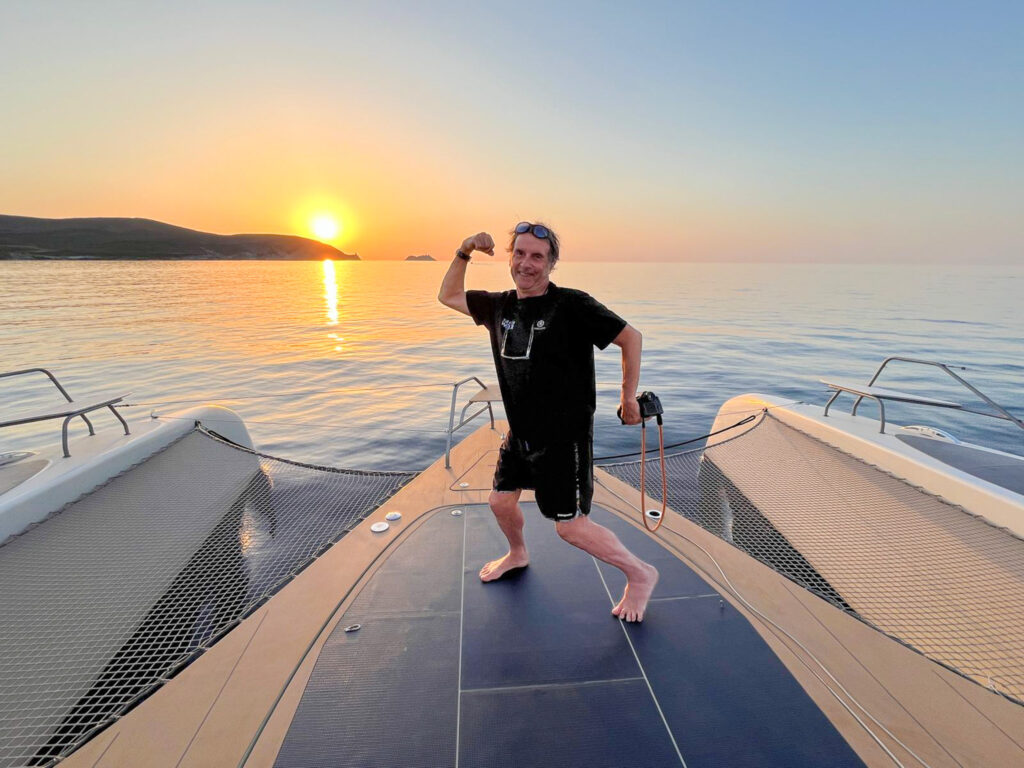
Eric Loizeau , the scribe.
Captain la Houle