May 9th
Out at sea!
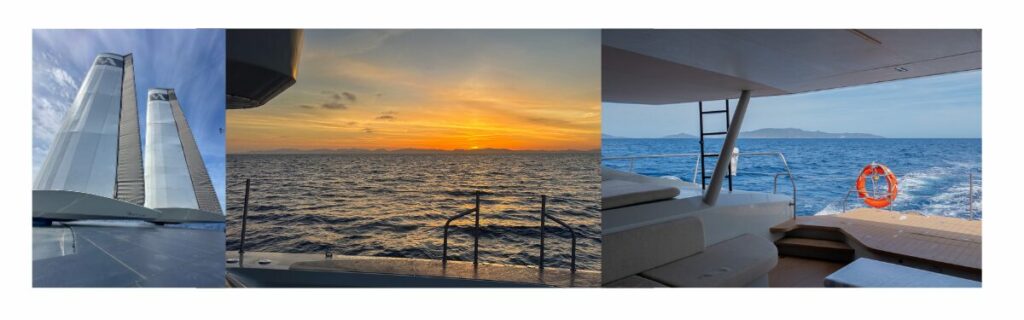
It’s five in the morning, dawn is breaking, and I’m taking over the three-hour watch from the Captain. I’m in luck: the wind, which had been nonexistent until now, is finally picking up in the right direction—that is, coming from the port side, at about ten knots. Engines off, the sea calm, our two sails, properly set by the Madintec computer, propel us at roughly the same speed toward Sardinia. On the not-so-distant horizon, we can make out the rugged contours of Corsica, soon to be bathed in the first rays of sunlight that chase away the moon’s silver glow. It’s as beautiful as a painting by Monet or perhaps Pissarro! In the distance, I make out the misty outlines of the Asinara Point, blending into the gray of the sky. At dawn, cirrus clouds were streaking across the sky. “Morning cirrus, sorrow!”—we shouldn’t expect good weather today!
Bad news this morning! Our sweet little finch is no longer with us. Arnaud found him lifeless on his bunk. He didn’t survive his sea voyage and must now be wandering like a ghost between the waters!
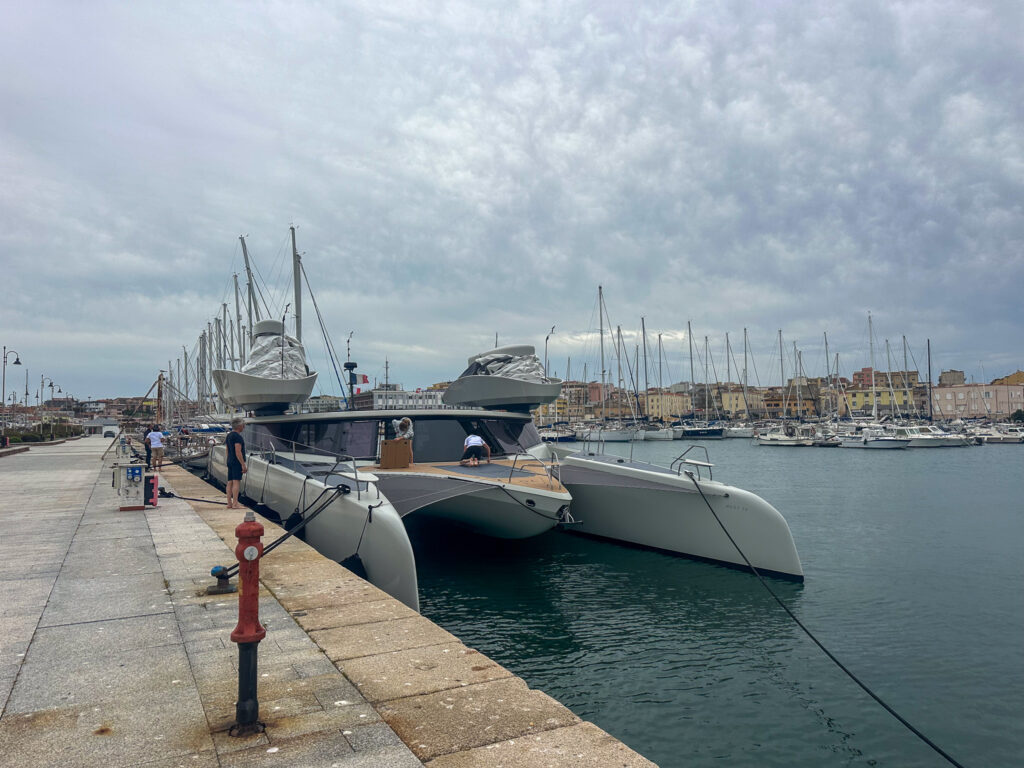
Little by little, the wind is picking up a few notches! That’s a good thing, because our speed is increasing! We’re finally leaving our navigation charts behind, and soon the outlines of the coast and the jetties marking the entrance to the harbour of Porto Torres—our first stop in Italy—come into view. It’s raining! The marina’s pontoons are empty, and life seems to have come to a standstill in this dreary port on this gloomy spring Saturday—you wouldn’t think so! Alone on his RIB, a harbour guard directs us to our spot: an uninviting gray concrete pier where we finally dock after a maneuver that was far from easy but expertly executed by our Captain.
We arrive just in time for a leisurely, unhurried lunch, followed by a nap, before welcoming Ariana, our first Italian diver—a petite, friendly, smiling brunette who’s not averse to a glass of wine for an aperitif. That’s a good sign!
MAY 10TH
"We could be in Concarneau," remarks Ploc (aka Bruno) as he scans from the bridge the dark clouds hovering in tight ranks above the harbor, with rain falling unexpectedly in this location."More like St Nazaire!" retorts Jean-Marc, a pure Breton from Île de Sein who insists we respect the beauty of our Brittany. It's not encouraging for the course of this first day of diving, but chin up! After our charming Italian diver rejoined us with her tanks, we bravely set sail toward Isola Asinara (I'm putting myself in Italian!) where the first swim is supposed to take place, provided the still quite rough sea consents to calm down.
I take the opportunity to have Plic (aka Patrick) explain the ins and outs of their mission. Unlike last year, when it was exclusively about determining the position of Posidonia fields to know whether they had regressed or progressed, by searching for buoys deposited more than forty years ago by the GIS of the same name. This time, our diver-researchers' mission is to determine the quality of ecosystems present within the seagrass meadows: fish, sponges, sea urchins, crustaceans... The goal is to verify the relevance of the new EBQI (Ecosystem-Based Quality Index) protocol supported by the European LIFE program within the MARHA (Marine Habitat) project. Bruno specifies that they tested this brand-new protocol in France and would like it to be expanded to the rest of the Mediterranean basin. Hence the interest of this new mission alongside Italian researchers on their territory of predilection. 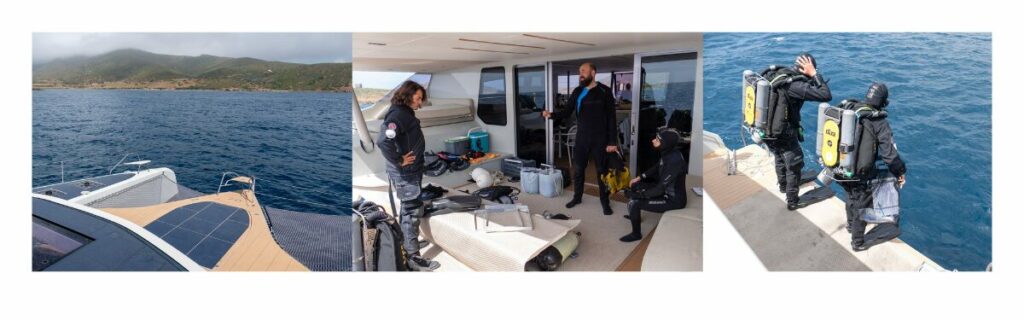 To do this, our adventurers of the depths will wander along virtual underwater "paths" fifty meters long by two meters wide, which they will explore meticulously, noting their discoveries with pencil (!) on special water-resistant paper sheets! Thus, in the age of generalized computing and the abominable AI, we're returning to methods that may seem archaic but prove resolutely effective! As predicted with the weather, which for once proves accurate, the sky clears as we approach the island, which reveals itself with an arachnean beauty, its green summits rimmed with morning mist. We stop our ship in a sheltered bay with a few houses with red tile roofs at the far end. Once anchored, the Gavitello (it's not an Italian cake but the name of the marker buoy), we send our divers down, equipped like cosmonauts departing for the moon... I'm always astounded by the weight of their equipment, the various tanks, compressed air, oxygen connected by countless rubber hoses. Fortunately, once submerged, Archimedes, appropriately named, solves the problem with his famous buoyancy. This first dive lasts seventy minutes at seventeen-eighteen meters depth. On the boat, it's rather cool! While monitoring the surroundings of the Gavitello, we can enjoy Aunt Marion's lunch, comfortably settled in the MODX's superb mess. The wind established from the west, accelerated by a Venturi effect at the bay's opening, simply forces the Captain to occasionally correct our drift with a few delicate engine bursts. The maneuver to recover the divers is delicate. One must come up gently in reverse toward them, calculate the drift due to wind, and especially stop the engines when arriving nearby. They are then relieved of their diving equipment so they can regain the board via the companionway ladder placed at the rear of the float. We give them a few moments of respite, the time to move the boat to the second dive site located a bit deeper in the bay. They courageously depart again for a second counting session. Surely they'll be very tired tonight!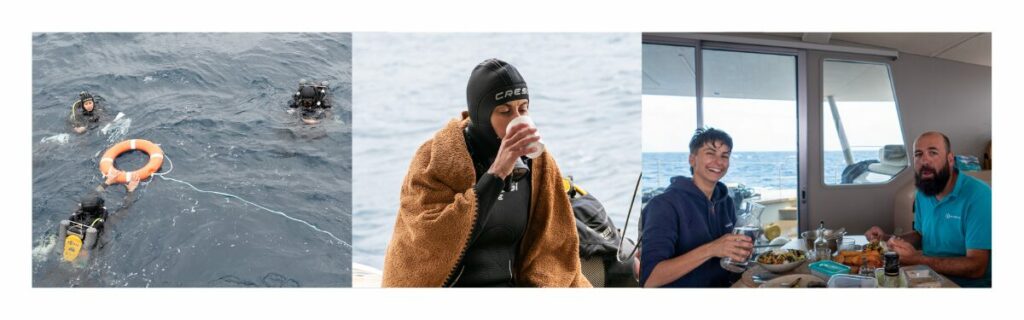
Upon returning to the dock in late afternoon, after methodically packing up all their gear, they compile the summary of their counts, which will later be compared with future observations planned every three years in the same MPAs (Marine Protected Areas). Provided research budgets keep up. It's always the same story!
MAY 11
Under a cerulean sky, the gulls resumed their graceful ballet this morning above our boat, moored in the same spot as the day before! This bodes well for a beautiful day ahead. However, Arianna, Patrick, and Bruno return disheartened from their meeting with the Maritime Affairs office (the Guardia Costiera), intended to validate the day's diving permits—particularly concerning a new site located on the coast approximately 5 nautical miles west of Porto Torres, a backup location imagined in case of excessively strong winds. The interview did not go well in front of an unaccommodating bureaucrat, who began by denying Patrick and Bruno entry to the office, leaving our young Italian woman alone to deal with the Authority!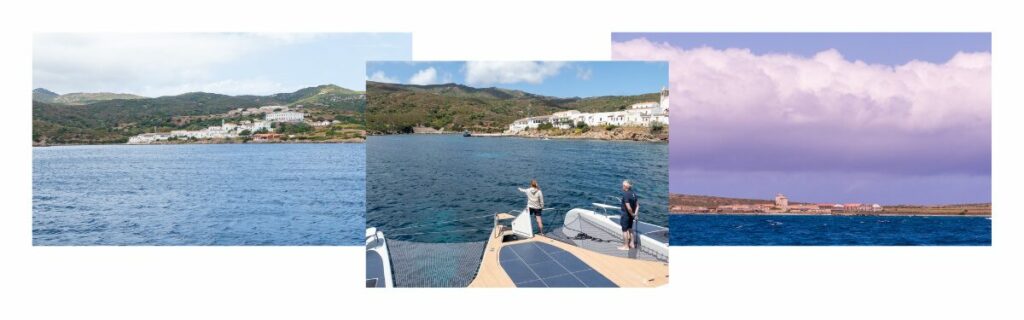
In the end, after lengthy and tense negotiations, we are authorized to dive only within the Asinara Marine Protected Area (AMP), hoping that the fresh southwesterly wind will allow us to operate safely offshore, a situation that worries our captain!
Before departing, we welcome aboard Alessia, our second Italian diver, which will allow them to respect the essential gender parity during their future explorations. This will spare them from resembling the island's albino donkeys, a unique species in the world, which suffer from physical and psychological depression due to the imbalance between males and females! At least, that's what they claim.
As expected, the originally planned site is not feasible due to the wind blowing toward the shore and a wretched chop. In desperation, we consider diverting to a cove further north, provided we obtain the green light from the Authority. Ultimately, this impromptu program change will prove beneficial to us. The small village we discover, magnificent, shines under brilliant sunlight. A few white houses huddle tightly beneath the bell tower of a tiny church. We drop a welcome buoy a few cables from the shore. Our divers are eager as horses before oats upon discovering the crystal clarity of the water. I notice a strange blood-red house with white shutters standing in the water—a more recent construction that stands out in this vintage landscape. Arianna, our benevolent local guide for this stop, explains that this was once inhabited by the famous judge Giovanni Falcone, God rest his soul, when he was preparing with his counterpart Paolo Borsellino the trial against the Cosa Nostra mafia bosses, whose supreme leader, the sinister Toto Riina, was incarcerated in the nearby prison to facilitate his interrogations. Indeed, before sheltering albino donkeys and disabled sea turtles, this paradisiacal island housed a penitentiary for the worst scoundrels of this world. To achieve this fascinating history lesson, it should be known that Cosa Nostra ultimately won this battle by brutally assassinating these two upright judges, with complete impunity.
Back aboard after ninety minutes underwater (the duration of a football match without extra time), our valiant explorers gather around Aunt Marion's table with a collection of ecstatic Colgate smiles that speak volumes about the quality of their underwater peregrinations. "Very nice seagrass bed!" concludes Patrick. "We did well to come," adds Bruno. As if to say, one should never give up on tense situations that can lead to beautiful stories.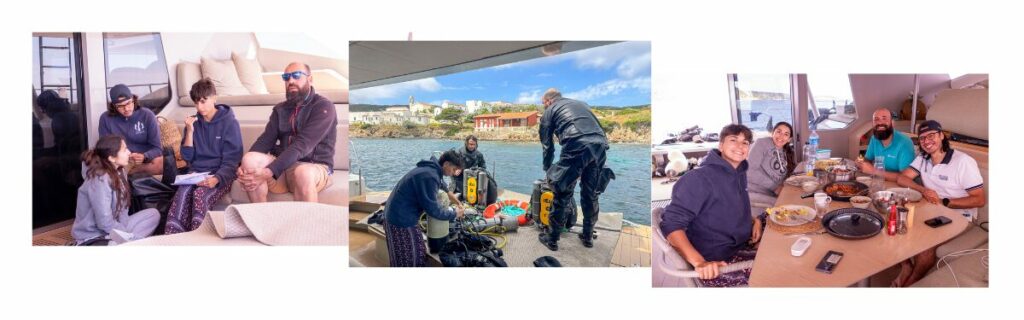
MAY 12,
It's 10 a.m. and we're still waiting for the visit from the director of the Asinara Marine Protected Area—the diligent official who authorized yesterday's dives on the island of the same name. We're growing somewhat impatient because we need to set sail for a forty-mile leg to the Capo Testa peninsula, at the northern tip of Sardinia, our next dive site. But as Arianna points out, "we must respect the Italian quarter-hour!"
Once these diplomatic obligations are fulfilled, as soon as we exit the harbor, we connect via video conference with a ninth-grade class from a high school in Bourg-en-Péage in the Drôme region.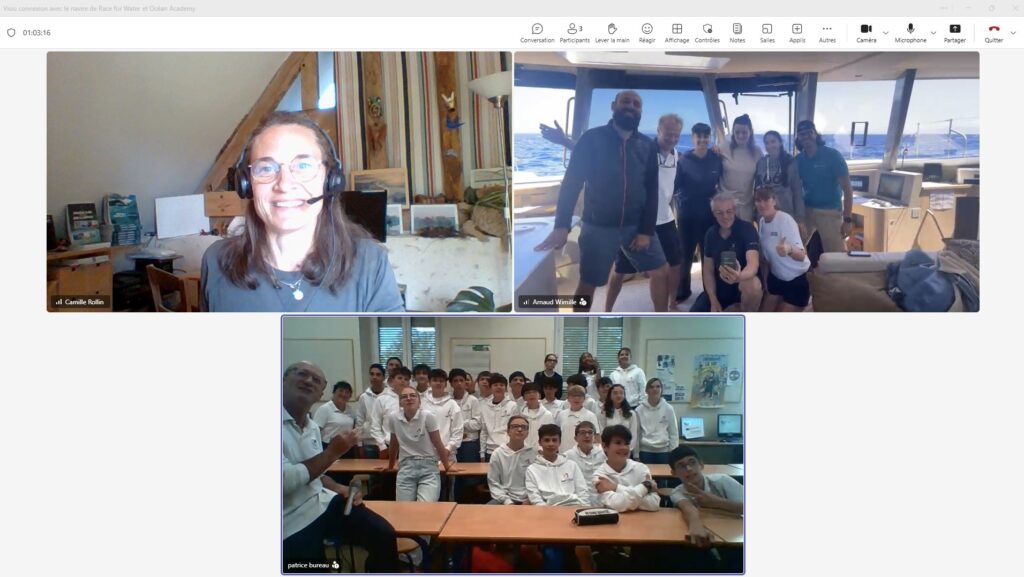 This allows our researchers to explain in great detail the secrets of Posidonia seagrass, the objectives of their mission, and their fascinating profession—which may spark career aspirations among this attentive audience. It's also an opportunity to introduce the crew and mention in passing the presence of an additional passenger since last evening: science journalist Marie Treibert, tasked until Naples with feeding our social media channels with anecdotes we hope will be suitably juicy.
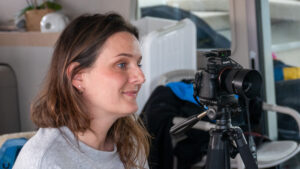
Marie Treibert
In the afternoon, the wind gradually builds up to force 7 in gusts; the deep blue sea grows rougher offshore and fills agile puffins with joy as they skillfully dart in the troughs of the waves. Some tinkering on the wing occupies our engineer and slows us down a bit on this chaotic route along the Sardinian coast, which we glimpse off the starboard beam. As a result, we don't arrive in time for the afternoon dive and decide to head straight for the harbor of Teresa Gallura, where our captain has reserved a spot with Federica, the suave harbor master! This minimalist shelter nestles at the bottom of a narrow fissure carved into granite that probably dates from the ice age.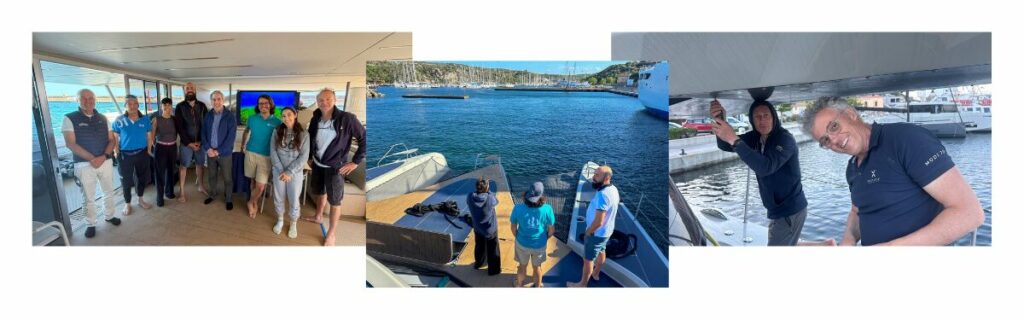
13 MAY
They're not afraid, those real estate developers!!!! That's my morning reflection as our boat gently shakes itself at anchor, while our four intrepid divers have gone off to explore the Posidonia seagrass in the wild cove of Marmorata, just a handful of miles east of Santa Teresa Gallura! How to uglify nature and desecrate magnificent sites! All this to build a seaside holiday village, some kind of gigantic gray concrete block that slyly recalls the sinister bunkers erected by the Nazis during the last world war (hoping this really is the war to end all wars!) along all European coasts. They call it the "Eco Mostro," the monstrous building in transalpine language! There's nothing to be proud of there! Unfortunately, let's remain humble, because we haven't done much better on our side of the Mediterranean.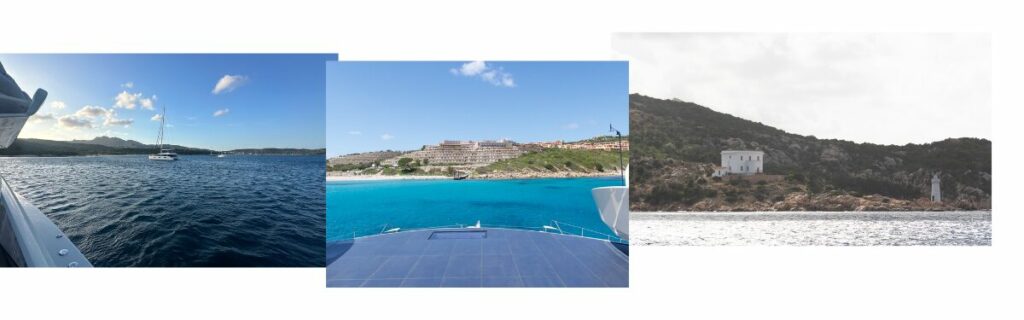
So, after bidding farewell to Jean-Marc, embarked as sad as a dead donkey on an ordinary ferry-boat heading to Bonifacio, as sad as the well-gray sky dripping rain that accompanies us out of the harbor, we set off again in search of new adventures toward that first anchorage where we hooked a large buoy near the shore, an ideal spot for a first dive, Patrick assures us in his respected capacity as expedition leader. Like a miracle from the Sardinian sky, the firmament suddenly clears and we find acceptable local colors again. Yes, we are indeed in the Mediterranean!
To keep fit, our new engineer performs some burlesque acrobatics, which amuse only himself and certainly not the Captain, to finally manage to pass our mooring line into the cove of this mischievous buoy, well assisted by our second (logical) armed with a long telescopic boathook, which she handles like a Teutonic knight wielding his sharpened lance (to stay in the atmosphere of the place). 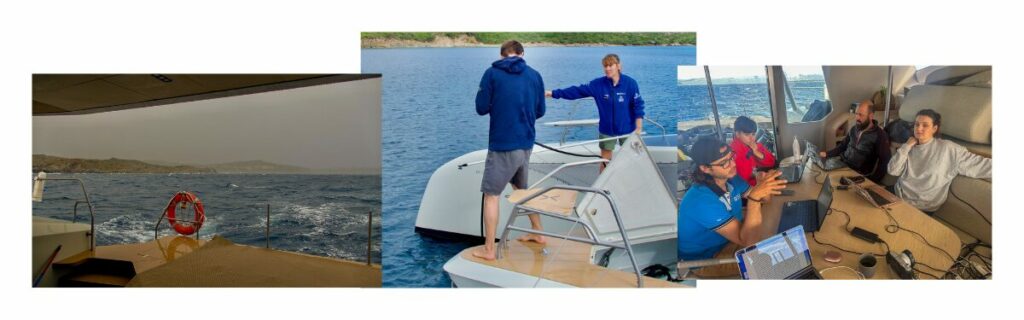
Our explorers of the silent world (reference to the counter-admiral commanding with the red cap), quickly gear up and disappear into the marine depths for two one-hour diving-collection sessions.They use two different breathing systems: our Italians have open-circuit scuba gear using depressurized compressed air thanks to the famous regulator developed in 1943 by engineer Émile Gagnan (well aware of compressed air since he worked at Air Liquide!), their French counterparts have "rebreathers," that is, closed-circuit systems using exhaled air recycled into oxygen thanks to cartridges (a very pretty name) of lime that capture carbon dioxide and return oxygen to the circuit. The advantage of this system is allowing longer dives without creating bubbles and paradoxically being safer. It was actually developed by Italian combat swimmers to avoid being detected by the enemy (in this case the French and British). Speaking of which, I recommend reading the novel "The Italian" beautifully written by the Iberian Arturo Pérez-Reverte.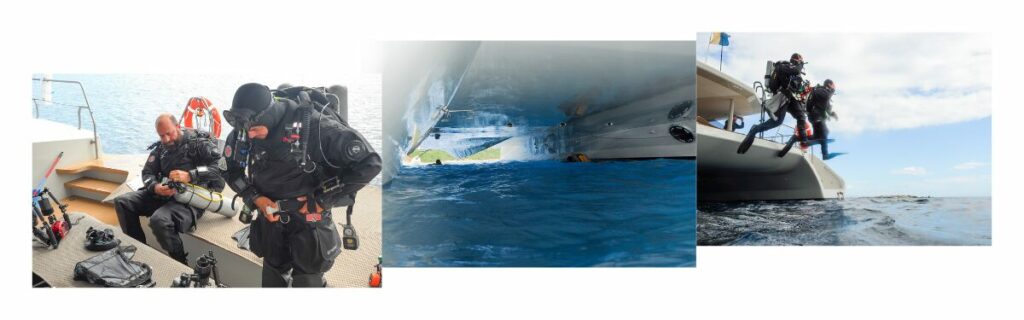
Anyway, after this brief literary parenthesis, let's return to our divers. Their observations report seagrass beds largely deteriorated by anchoring, which is explained by the beauty of the coastline and landscapes that must attract numerous pleasure craft. This is why authorities have put in place a cohort of mooring buoys that appear to be recently manufactured. It was about time! Apart from that, the seagrass bed seems healthy as described by Alessia, who, with her colleague, spent her dive meticulously counting the plants! I can't understand how they do it! We set off again in the northwest wind that doesn't weaken, searching for peaceful spots within the wild archipelago of the Lavezzi, south of the Bonifacio straits. In vain! All our anchoring attempts fail because they are all much too exposed to the wind to consider deploying our divers. In desperation, we decide to head further south to find overnight shelter on the East coast. This will have the advantage of bringing us closer to Olbia, our next stop, and considering dives in this area the next morning. Mid-voyage, we conduct a completely impromptu man-overboard maneuver. Rest assured, we didn't lose a crew member, but one of the deck mattresses that flew away in the turbulent wind. At least, it had the advantage of training the crew to react positively to this tense situation, the most feared by sailors and their captains. Our coastal navigation continues haltingly in search of a welcoming cove. After a first aborted attempt, in the slanting sun of twilight, we successfully drop anchor in the deep bay of Cala di Volpe, a few cable lengths from a sandy shore, near a few stationary boats, our companions for a quiet night. Finally, we hope so!
MAY 14TH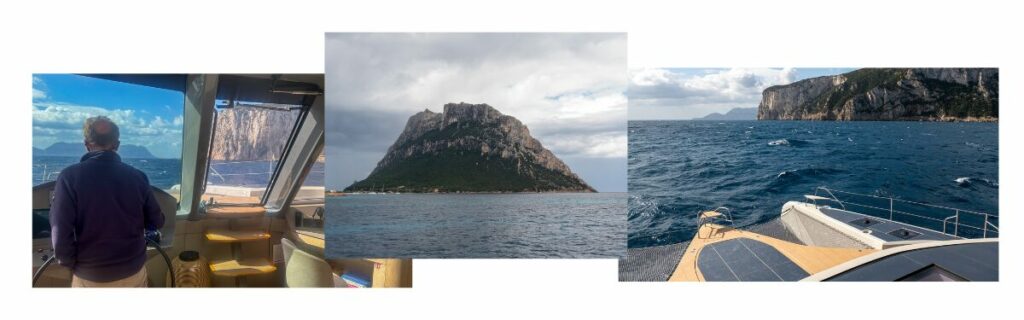
It is mentioned in the Old Testament that at the time of the Ascension, Jesus woke his disciples to send them on a mission across the planet. Similarly, aboard the MODX 70 Ganany, our brave captain sounds the alarm at eight o'clock sharp, rouses his crew to haul up our anchor quickly and efficiently, and set sail immediately for another day of adventures. As every morning, Aunt Marion has prepared a full breakfast because our divers will need an excess of calories to explore the icy depths of the Mediterranean. Indeed, the weather is strange this spring, with a nearly constant northwesterly wind that chills the atmosphere and freezes the water. Despite their adapted equipment, an hour at the bottom of the water without moving much, counting creatures, is long, and our deep-sea explorers often return aboard completely chilled and shivering.
This morning, we head toward the strange island of Tavolara located at the exit of the Gulf of Olbia. Imagine that it is a micronation governed by a constitutional monarchy, probably the smallest kingdom on the planet with a surface area of barely 5,000 square meters! It is a sort of enormous limestone block approximately 500 meters high, entirely elongated, rising from the depths of the sea during a distant cataclysm and offering very little habitable surface for humans. Consequently, it was long uninhabited and now counts only a handful of residents after having served as a hideout for Barbary pirates, but that was a long time ago. Once in a while, we struggle somewhat to find a suitable spot for the first dive. Upon arrival at the site, in this case a bay positioned west of Tavolara, the mischievous wind has the fanciful idea of shifting to southwest, which complicates our anchoring maneuver that we naturally want outside the seagrass beds. Once stopped, the procedure is always the same: divers equip themselves meticulously, check dive computers, air supplies, put on masks and strap on their fins. We send the orange "galito" bag buoy to the sea which serves to locate them, and also the safety buoy connected to the boat by a line, just in case... They then depart for an hour and thirty minutes of diving at 15 meters depth.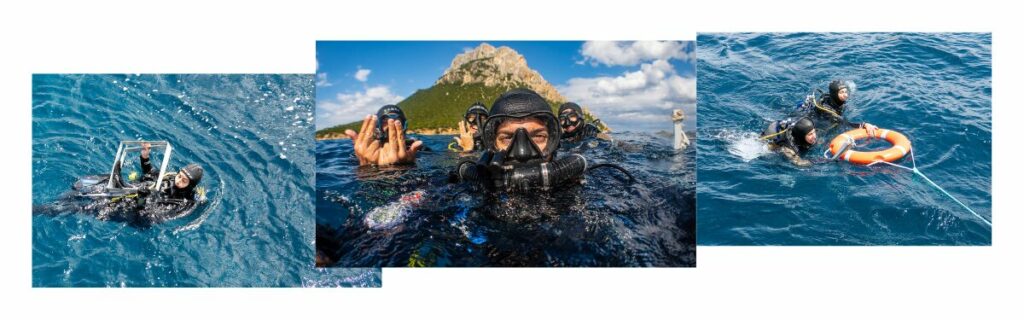
It is a long day! Upon their return and after a quick lunch, we depart immediately for the subsequent dives on Tavolara island, greeted by an unexpected rain shower in this location. As Breton sailors say, "heavy rain brings down strong winds!" This will make our lives easier. Fortunately, there are no possible anchorages in this bay invaded by Posidonia seagrass, nor mooring buoys. Thus, during the next two dives planned at fifteen meters then five meters depth, we will have to remain on standby, engines idling during their underwater work. Work for our captain!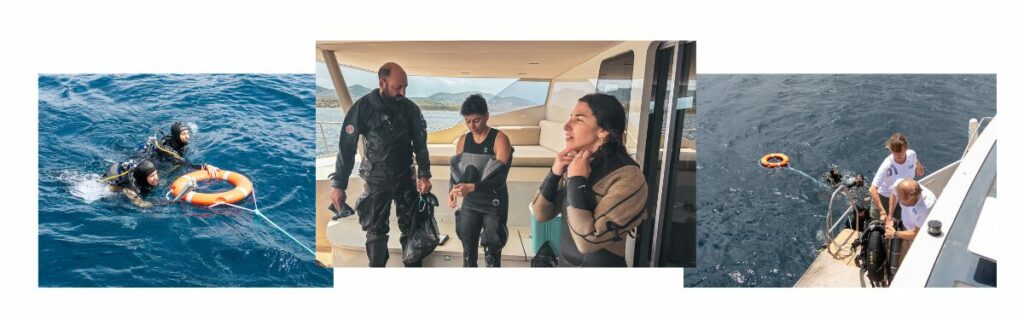 After an hour of exploration, we bring them back up shivering from cold. Regarding the seagrass beds, the assessment is not encouraging. Patrick explains that this site is "a textbook case" of bad practices by pleasure boaters who, more out of ignorance than indifference, destroy seagrass fields with their anchors and chains. This is a recurring problem in all tourist sites that suffer from overcrowding, like today where five pleasure sailboats are anchored peacefully at some distance from the beach, right in the middle of the green expanses of Posidonia.
Tonight we are docked in the port of Olbia. With a tear in the eye (and it is mutual), our pretty Italians leave the ship hoping to return soon. Alas, a thousand times alas, we will not have the opportunity to visit the local taverns to taste one last glass of Sardinian wine because we depart tomorrow at sunrise, on route to the middle of the boot—you have understood that this refers to the Bay of Naples. Good night, little ones!!!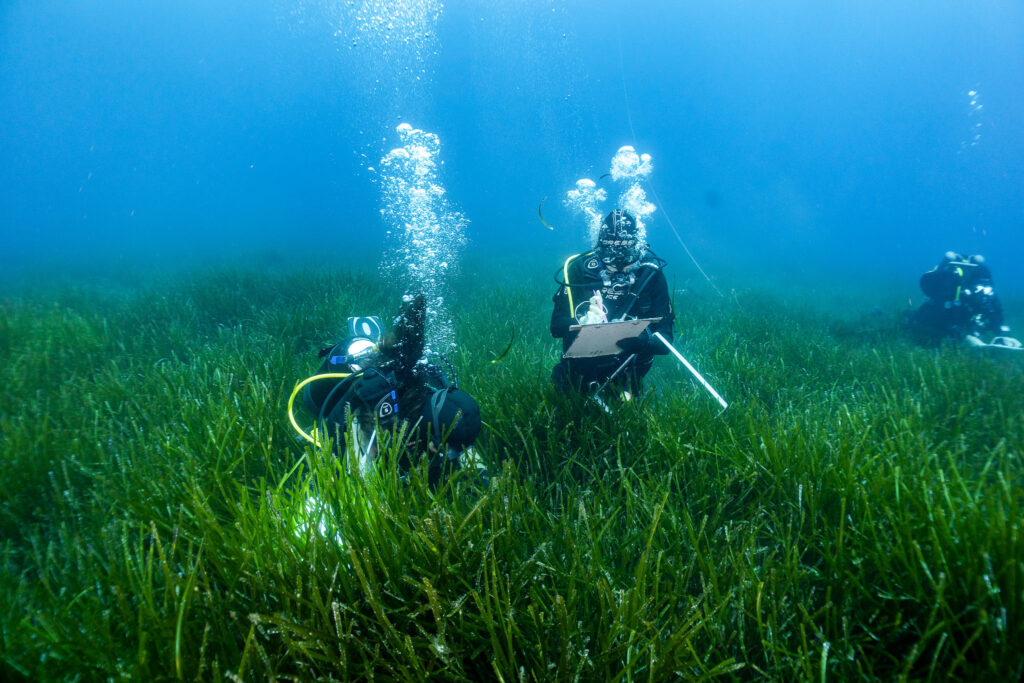
MAY 15TH
Our crossing of the Tyrrhenian Sea between Olbia and the Bay of Naples begins quite slowly. A cold, glacial light, worthy of Norwegian fjords, accompanies us throughout the narrow channel exiting the harbor. To top it off, virtually no wind forces us to use our electric motors to glide in sepulchral silence over glassy seas, between mussel farms immersed in fluorescent baths of diesel fuel. What a preposterous idea to install them in this spot; it smells of tar! The Sardinian crustaceans must taste of petroleum!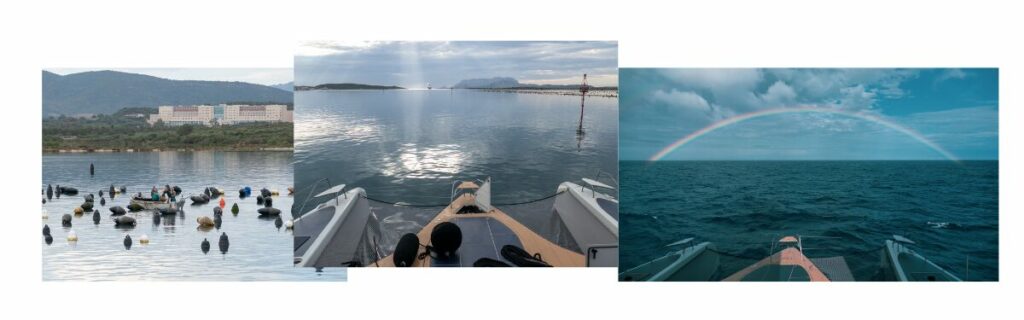
It's the height of bad luck: throughout the preceding days, a violent mistral had disturbed our divers, turning dive sites into wave-making factories and ice baths. And now today, our wings would gladly need such conditions to propel us at good speed toward the Italian coast, nearly 200 miles away.The outlines of Sardinia take their time leaving the horizon. The sea is gray; one might think we're on the Grand Banks of Newfoundland, and cod have replaced sea bream. Nevertheless, this fair weather allows our divers to assess the first part of our mission. They show me underwater photos of Sardinian Posidonia seagrass, often damaged by the anchoring of thoughtless pleasure craft in marine areas that should be protected. I remind those who may have forgotten that this seagrass plays an essential role in carbon capture and oxygen release into the atmosphere through photosynthesis (we need it more and more), and serves as shelter for numerous endemic species that are tending to dwindle or disappear (we need them too). Consequently, according to observations by our local diver-scientists, the aquatic fauna appears much less abundant than usual. Their explicit images show wide furrows traced through the seagrass beds by the movement of metal chains acting like malevolent harrows, with rare schools of fish swimming around.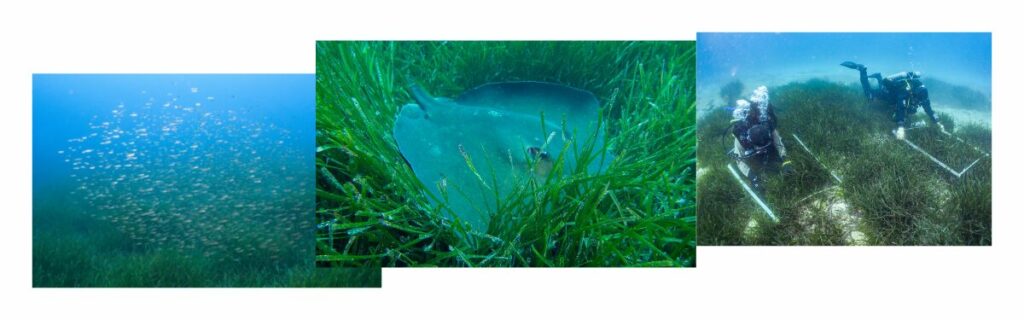
Around noon, as we prepare to sit down at the table, the wind finally returns from the right direction, west-northwest, vindicating the forecast files. Our wings awaken and shake themselves with joy: finally we can cut the engines and rediscover the delights of sailing! We resume the watch schedule: four hours during the day, three hours at night. I'll take mine until eight o'clock tonight, and I'm already looking forward to a good night's rest, since I won't resume until five o'clock tomorrow morning. At aperitif time, leaping dolphins come to frolic around the bows, drawing sighs of ecstasy from the female members of the crew who gather, swooning, on the balcony!
And night comes, wrapped in its mysteries. The wind picks up, and so does our boat. We're expecting around thirty knots after midnight. If all goes well, we won't be late arriving at the beautiful island of Ischia, situated at the entrance to the Gulf of Naples, our next adventure ground.