MAY 16, 2026
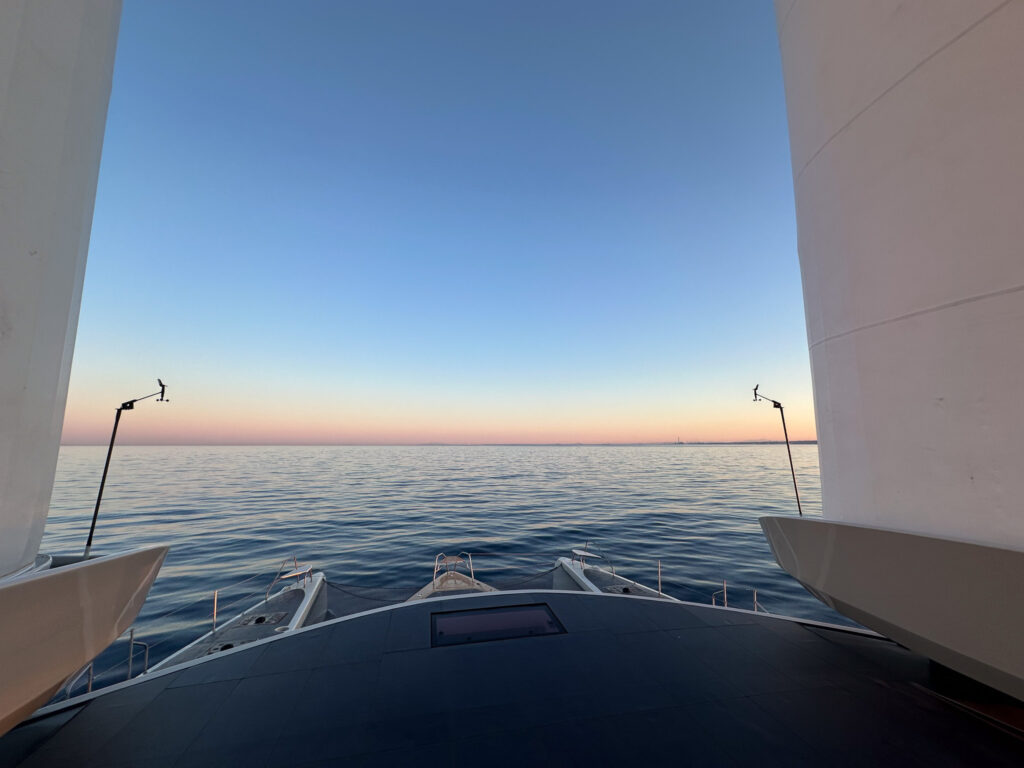
Two graceful white gulls frolic before the bows of the remarkable catamaran Ganany, firmly moored at the honorary quay of the charming port of Ischia. We have just arrived, coming from Olbia which we left yesterday morning. A snail's departure due to virtually non-existent wind. Fortunately, by the end of this first day of sailing, we had aligned ourselves with our weather forecast files, to such a degree that during my watch at five o'clock in the morning, I woke up accompanied by the characteristic sounds of water streaming against the hulls. I go to relieve Arnaud, standing solidly on his legs before the helm station, attentively monitoring the luminous dials of the dashboard which indicate, among other things, the true wind force and its direction. Outside, the night is pitch black and the bows of our floats glide forward, triggering shooting stars of phosphorescent plankton. I will leave Lord George, our pilot (his latest nickname), to steer conscientiously for now. I'm having a bit of trouble getting used to the comfortable interior of this cell in which I don't perceive the wind on my face, nor the sound of the sea. I am alone now, like a shepherd guarding his sheep, I watch over the crew who sleeps. I monitor the wind and the course. We are nearly seventy miles from Ischia and much closer to the three islands of the Pontine archipelago that we will leave well to port in about an hour. The black screen of the radar signals no boats around us; I am surprised by the weakness of maritime traffic—could it be due to restrictions caused by the blocking of the Strait of Hormuz and the rise in diesel prices, which of course doesn't affect our vessel, totally exempt from fossil fuels. Outside, the wind strengthens, between twenty-five and thirty knots true that we receive from three-quarters aft, broad reach for those who understand the complicated language of sailors, with our two wings widely deployed perpendicular. The sea goes from rough to very rough, short too, a characteristic of the Mediterranean.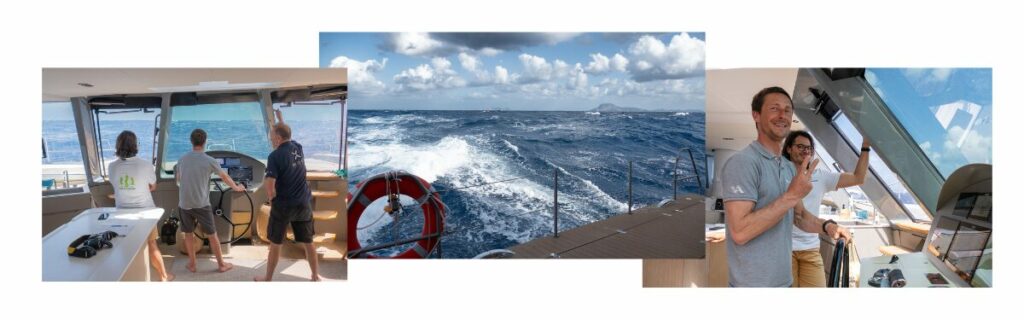
With amazing synchronization, day breaks and so does Martin! Soon followed in order by our two adventurers of the depths, then our tranquil sailor, Arnaud remaining on standby in his cabin, sleeping with one eye open like any proper captain who respects himself! It's a bit clearer now. The turbulent wind chases away the clouds, the beautiful sea (not the mother-in-law) takes on an indigo blue hue through which Ganany bravely traces a double straight wake of immaculate whiteness... opalescent, I'd even say more! I relieve our pilot at the black carbon helm and open the hunt for the record he holds at 21 knots! I am pleasantly surprised by the hellish reactions of the boat that I'm directing for the first time in these muscular conditions. It behaves practically like an offshore racing multihull, reacting to the slightest turn of the helm we give to place it in the wave that runs and launching into long surfs above 15 knots without the bows drinking the cup. Not bad for a pleasure boat with luxurious arrangements imagined without concessions to the weight budget. The architects of VPLP (Editor's Note: highly renowned Vannes architecture firm, designer of the world's best ocean racers) can be proud of their design.
For now, our record hunt continues. Martin reaches twenty knots not far behind Lord George; I follow at nineteen point five, but Arnaud gets everyone to agree with a peak at twenty-three knots, in front of witnesses, therefore officially validated. Normal, he's the boss! This will cost him the champagne upon arrival! The advantage of this record hunt is putting us ahead of our forecasts, so we cross the line in front of Ischia Porto at exactly 1:00 PM, after delicately folding our wings (much more poetic than dousing). Twenty minutes later, after an impeccable maneuver, we hook the two pendilles (endemic mooring system of Mediterranean ports), immobilize the boat, its stern one meter from the quay, right in front of the Captain's Office. Practical for formalities!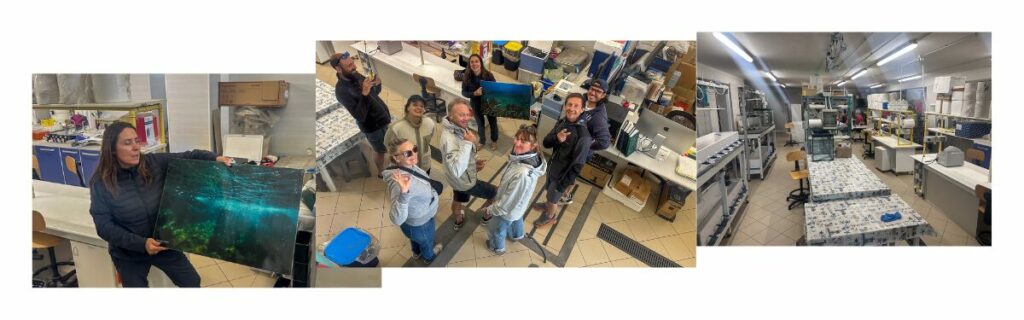
Barely time to catch our breath, we are greeted by a vivacious woman whom we initially took for a port official or the owner of the neighboring boat, depending! In reality, she is Dr. Nuria Teixido who manages the Naples stage. Very directive but also friendly, she immediately takes care of us who leave staggering (due to land sickness) to visit in order, her laboratory, of which she is very rightly proud, a beach, I don't know why, and finally, the long-awaited moment, the Italian bistro of our wildest dreams with Gelati, tiramisu and cappuccino... in abundance! Yes, our Italian stopover looks good, especially because tomorrow Sunday we have a layover! No dawn wake-up, which will probably allow some and others to tour the night bars and other places of perdition. I'm a tomb and won't name anyone!!!!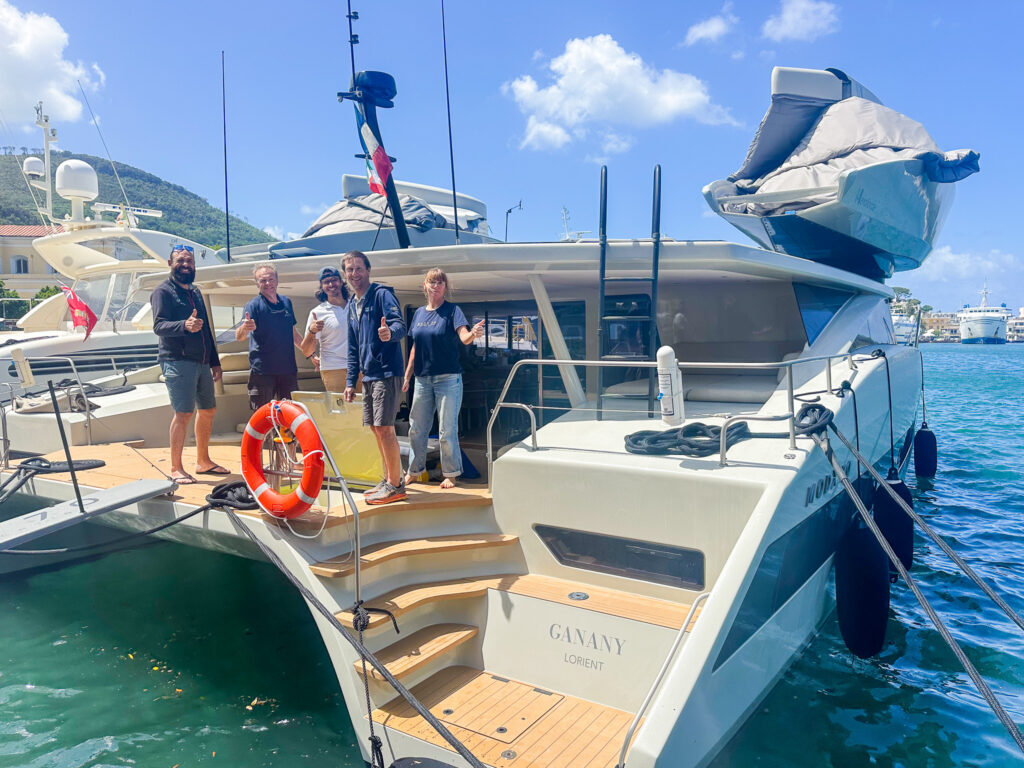
MAY 18TH
Today, business resumes aboard Ganany after twenty-four hours of well-deserved Italian-style dolce far niente. We were joined by Marco Simeoni, founder and president of Race For Water, and Camille Rollin, our coordinating director—in short, my boss! By the way, a wave of panic swept through this morning as we rushed to tidy up on board, having misunderstood that Marco would arrive at eight in the evening rather than eight in the morning. It's a long day organized in coordination with the Ischia scientific station directed by Nuria, more precisely the Stazione Zoologica Anton Dohrn, named after its German founder.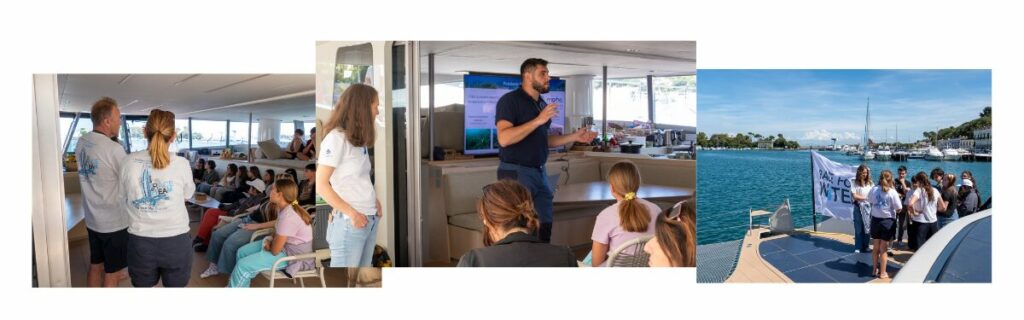
In the morning, we receive two classes from local schools, about thirty students from high school and middle school in two separate groups accompanied by their teachers. It's strange, I note that in Italy there seem to be more female school teachers than men. Could this be a matriarchal activity? The activities of the local "station" are explained by Emmanuel, a handsome Italian with Popeye-like muscles who holds his young audience spellbound with his charisma and the quality of his explanations. Marco and Camille, for their part, present the Foundation, its various unusual boats, and its different planetary missions undertaken since 2010. More than fifteen years already! How time flies! Fifteen years that we've been fighting around the world for ocean protection, battling unnecessary plastics, seeking solutions, defending Posidonia seagrass and insufficiently protected marine areas, without noting spectacular progress. I was talking about this earlier with Marco, whose foundation is financing the entirety of our expedition this year because it wasn't possible to find either financial partners or government aid. Meanwhile, arms dealers are getting rich and missiles are exploding in all directions, polluting the atmosphere that we try to preserve through our "Don Quixote endeavors" that interest almost no one. Fortunately, there are wonderful people like these scientists we encounter on board who still maintain a glimmer of hope in this uncertain future. As for our foundation, to complete the entire Posidonia Connect project by the end of 2030 and explore a significant portion of the Mediterranean basin, we'll need to find additional funding.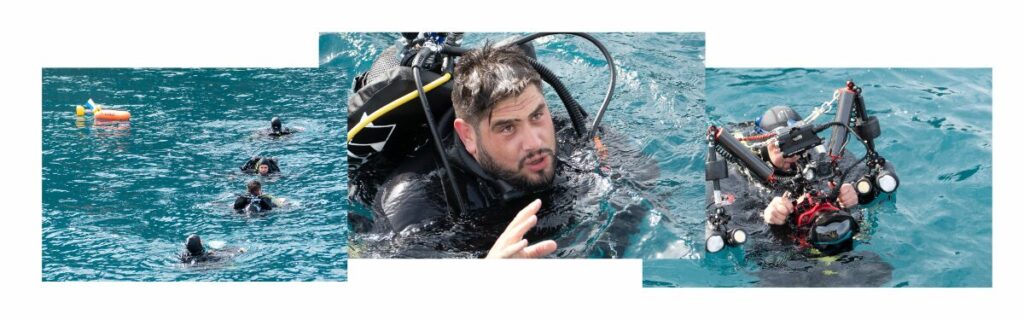
But let's return to our divers. After the delicious lunch prepared by Marion, we set sail toward a charming little port in an all-white town, Lacco Ameno. One could think they were in Morocco. Today, the goal is to explore this pretty bay that serves as anchorage for many pleasure boats, with the resulting disasters concerning Posidonia seagrass beds. Today there are five divers, since two scientists from the Ischia station and an underwater photographer equipped with an impressive camera (it looks like a giant octopus with long tentacles) have joined our two certified divers. That's a lot of people in the water at once, and there's crowding on the aft deck for everyone's equipment, which is always very meticulous. As Marco notes, “the hardest part of diving is gearing up!” There's no question of using our anchor, and our captain will have work to keep the catamaran stationary during the ninety minutes the exploration should last. Fortunately, the western tip of the bay protects us from the thermal wind that's beginning to rise, and the swell is virtually nonexistent. Under these idyllic conditions, Marie, our onboard science journalist reporter (I always struggle to pronounce and write this barbaric word), can finally use her drone and capture beautiful images of our boat from the sky. 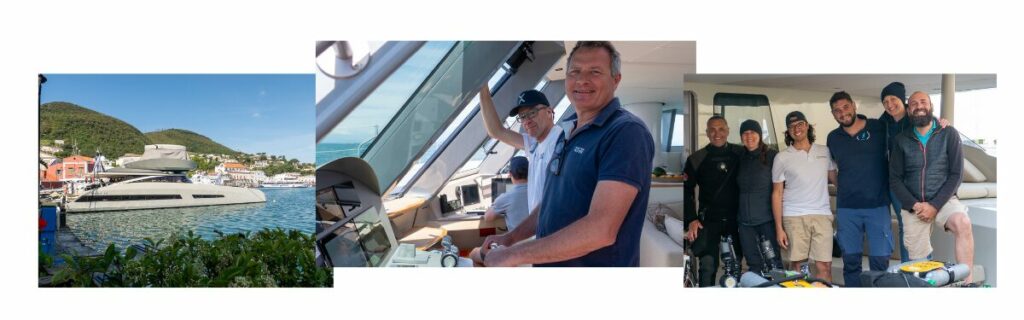
The afternoon is well advanced when, after bringing all these people back on board, we return to port, with the wind directly behind us, our two swan wings fully deployed. We take advantage of this to launch a series of tacks that can be performed automatically, just by pressing a button on the dashboard. The autopilot takes care of everything, and the two booms pivot smoothly above our heads. A marvel of technology that fits well with the design of this revolutionary boat.
May 19th
We begin our second day of exploration diving around Ischia island. Today we're changing zones. That's what Emanuele (aka Popeye) and Nuria explain to us on the Ganany's aft deck during a gesture-filled briefing (Hey, we're with Italians!). It's decided we'll head to the southern part of the island. After skirting a wild coastline devoid of modern construction, we find a quiet shelter at the foot of a gray limestone landmark—a sturdy structure that, according to our Ischistan friends (you guessed it, that's what the island's inhabitants are called), has braved several centuries of storms and various outrages. Here the cliffs drop straight into the sea, bordered by black pebble beaches. One could think we've returned to very ancient times when these lost places were inhabited only by screaming gulls and other peregrine falcons. This suits our divers, to whom a drone pilot has been added—an Italian with graying hair and an austere face he conceals under an astonishing mask that gives him the look of an antique Bacchus. Nuria confirms we're in the right place and the same routine sets in: depth check, launching the buoy, divers concentrating as they check their equipment like pilots before takeoff, engines stopped, captain's okay, synchronized plunges of Plic and Ploc and the others too. Surfacing after ninety minutes spent at fifteen meters depth, lunch at Aunt Marion's, then resuming the program without downtime. At this pace, I tell myself they could keep their frogmen suits on just to put their feet under the table! We'd save time!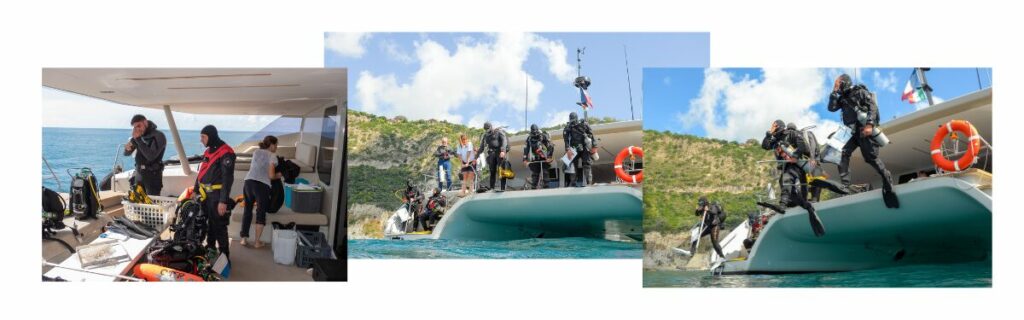
This afternoon, swimming takes place a bit further under the monastic surveillance of the Aragonese Fortress, which stands austere on a volcanic rock island in front of Ischia's harbor. Built nearly 500 years before the birth of our Savior, it was first called Castrum Gironis, then modernized by a passing Aragonese, hence its name. A wooden bridge that still exists allowed the island's inhabitants to seek refuge behind its powerful walls and thus protect themselves from Barbary pirates who were barbarizing the Mediterranean. After the Iberians departed, the fortress returned to the Italians served as a prison for political detainees and long housed monks with strange customs, including letting themselves rot in clay holes, the famous scolatoi, to meditate on life's fragility. I'm not making this up!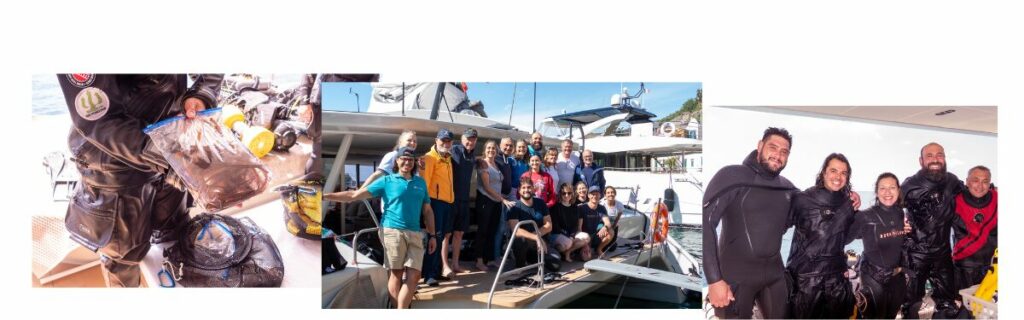
Once this fascinating page of history is turned, our intrepid divers reappear and share their observations. Once he catches his breath, I go get Bruno to talk—the most Italian of the French divers we have in stock. He explains that the morning dive revealed a site for once devoid of impacts on Posidonia, probably because of the huge rock blocks scattered across the bottom, but also due to exposure to prevailing winds blowing from the south during summer, which makes it unsuitable for anchoring. The bay explored in the afternoon is characterized by CO2 emissions revealed by a myriad of silver bubbles rising toward the surface. "This acidification of the site," Patrick explains, joining the discussion, "is due to the region's volcanic activity, which likely affects the seagrass beds by removing calcium deposits from the leaf surfaces." A boon for Sarpa fish, the only small herbivorous fish in the Mediterranean, to feed more easily. "What's curious also," Patrick continues, "is that we observe only CO2 emissions, no sulfur or methane, no temperature increase either, unlike other volcanic sites." "Probably due to the specificity of the local magma," Nuria adds, who had been listening to the conversation.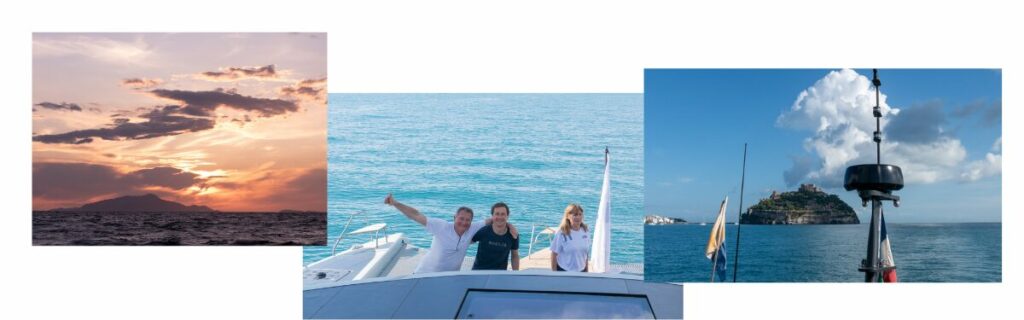
After this scientific interlude, we reach our Ischia anchorage so our divers can refill their tanks and also proceed with a crew change, welcoming Antonia, a young researcher from the Stazione who will accompany us at least as far as Naples. To take advantage of the powerful thermal, our captain decides to set sail immediately for our next destination, namely the Sorrento Peninsula, where we should find a decent spot to drop anchor or take a mooring buoy, which would be even better, to spend a quiet night and allow him to sleep soundly.
MAY 20TH
It all begins at dawn with our engineer departing for his Lorient office for a few days, seemingly uninterested in our upcoming Neapolitan adventures. How will we manage without him? As day breaks, we discover a heavily frequented cove surrounded by rather unattractive modern houses and numerous motorboats of various sizes circling us. Clearly, when it comes to pleasure boating, the engine is king! Y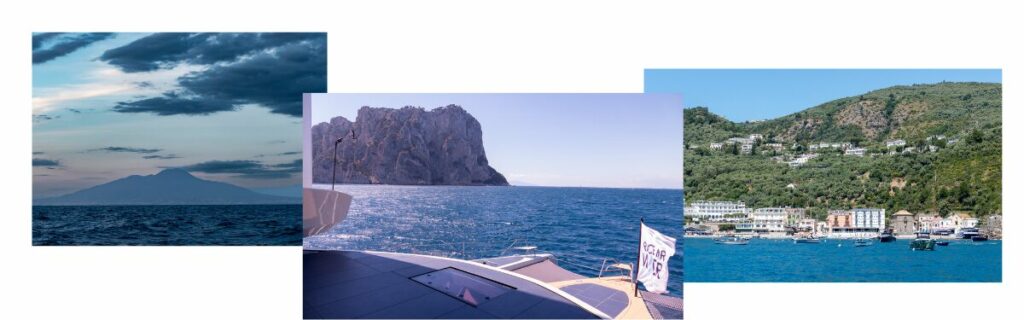 esterday, looking at the map, we thought we'd arrive somewhere wild, far from human presence. That plan failed! But the water is clear and transparent, promising a beautiful dive for our scientists who are already on high alert while we quietly move our MODX 70 catamaran Ganany a few cables away to reach depths under fifteen meters for initial observations of the Posidonia seagrass. Once our boat stops, Bruno tosses the "berlingot" (the Galito floating buoy we use to locate divers) overboard before putting on his modern diving gear. Each time, he mentions thinking of the old-timers called "pieds lourds" (heavy feet) because of their weighted equipment, supplied with surface air through a hose—the "narguilé"—connected to a manual pumping mechanism. Of course, you couldn't stop pumping, like Dupont and Dupond in the Tintin and Snowy adventures that shaped our childhood. It was a very dangerous profession that ended after the war thanks to the appearance of autonomous diving suits, similar to those used by our underwater scientist team aboard Ganany.
Returning to our four divers on this Franco-Italian mission—two Italians and two French—they set out again to explore the grassy Posidonia bottoms, counting leaf bundles, mollusks, sponges, and fish for exactly ninety minutes. You don't realize how long these dives are when you're waiting comfortably aboard. It's still the duration of a football match. By the way, these days there's not much talk about round ball in Italy since the iconic Squadra Azurra won't participate this summer in the World Cup organized by Mr. Trump!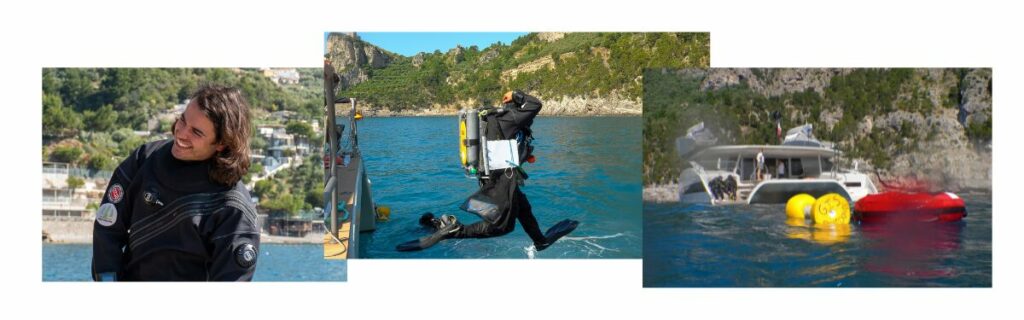
Regarding our two French divers, I found them a bit tired during the endless pre-dive briefing. Indeed, since our arrival in Sardinia, they've accumulated practically two dives per day with long sweeping and counting sessions requiring great concentration. This doesn't affect their perpetual good cheer or their appetite when it comes to putting their feet under the table and enjoying the fabulous cuisine Marion treats us to daily. But today their immersion time will be shorter! To respect the mandatory two-hour interval between each long dive, we won't reach the next spot until early afternoon. It's located in a narrow cove poorly protected from the westerly thermal wind that blows strongly from midday onward. Arnaud rightly assesses the situation looks bad, since at the slightest problem, we could be driven ashore. That's a bit of a sticky wicket.!
Thus the decision is made to give up and head straight to our next stop, 20 miles further west, on the other side of Naples which stretches languorously beneath the sleeping Vesuvius, precisely at Bacoli, on the edge of the famous Gulf of Pozzuolini, famous for the submerged site of Pompeii ruins called in Italian Parco sommerso di Baia, the submerged park of Baiae. I owe all this useful information to the delightful scientist Antonia, who spent her entire childhood in Naples.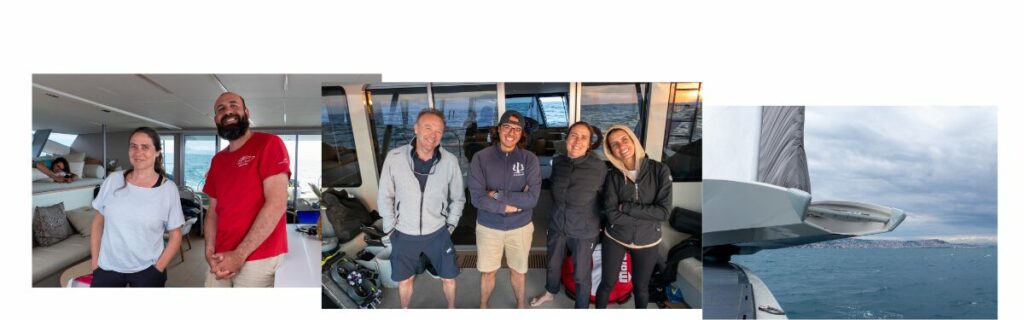
So it's a beating-upwind navigation (tacking) that will allow us to test the efficiency of our rigid wings to sail against the wind. Before day's end, we reach our goal and drop anchor at 8 meters sandy bottom, close to shore, under the protection of a Spanish-built fortress erected in the 15th century about fifty meters above the bank, with the added advantage of being right at the location of the next dive site, saving the crew from moving the boat tomorrow morning, with the promise of a peaceful night. Goodnight, little ones!
MAY 21ST
EARTHQUAKE
At anchor beneath the perched citadel of Castello di Bahia, we had been promised a quiet night, when at 6 o'clock in the morning a violent explosion shook our ship, waking the entire crew who rushed onto the upper deck in their underclothes, wondering what kind of attack this could be during such a belligerent period! Or perhaps it was an improvised surprise to celebrate Marco's birthday, our commodore, who was turning sixty that very night! Part of the cliff beneath the citadel had collapsed in a thick cloud of dust, and our charming regular passengers from the region leaned toward a seismic tremor. Our eyes immediately turned toward the proud Vesuvius to see if it hadn't awakened, transforming Naples into a new Pompeii. No smoke or fumaroles on that side, so we were reassured. Soon social media lit up to announce an earthquake of magnitude 4.4 on the famous Richter scale (God rest his soul), whose epicenter was located in the Gulf of Pozzuoli at a very short distance from our peaceful anchorage, hence the intensity of the tremor! To our great surprise, this event caused general panic in the diving community, to such an extent that a certain Bruno—and I assure you, not ours—a shadowy official holed up in a small office, forbade our two female divers from operating today, fearing fumaroles or other toxic gases that could, who knows, surge from the depths! Thus their two colleagues would replace them and carry out an 80-minute exploration dive. "It's starting to get long," remarked Patrick as he shed his equipment on the aft deck.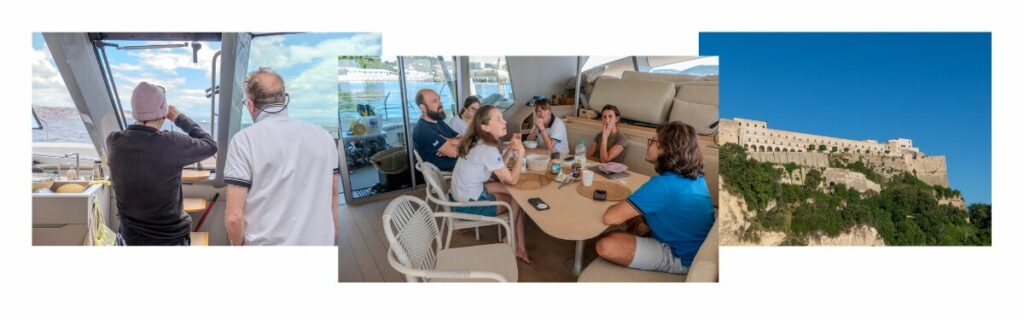
As soon as our divers resurfaced, the crew immediately set to work raising the wings (rather than setting sail) because we were expected in the early afternoon at the end of the naval base in the port of Naples, our next stop, and as everyone knows, it's better not to keep the military waiting! We found ourselves docked beside a coast guard ship from another era, alongside a long blood-red building housing the admiralty offices and also the Admiral's apartments. A passing sentry asked Caroline, our pretty washerwoman, to remove the cohort of various linens drying on the lifelines, and Nuria urged me not to make too much noise. We must not consider ourselves in conquered territory. Apart from that, the anchorage was peaceful, well-guarded by the army, close to the city center. 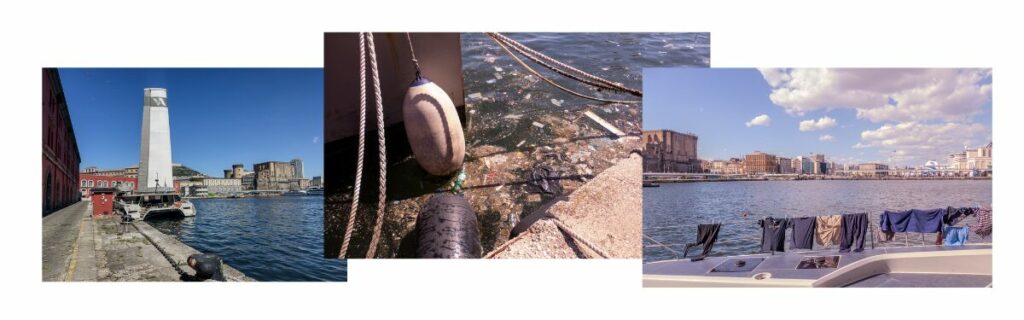 Well, we wouldn't be swimming in the port water, despite its beautiful chocolate color, but adorned with a host of multicolored waste of all categories, ranging from counterfeit Coca-Cola bottles to used condoms, not to mention the inevitable single-use plastic bags! On this beautiful Neapolitan afternoon, the crew went about their business: preparation for the big day tomorrow for Camille and the scientists, tidying the boat by the crew, studying weather files in anticipation of our next navigation toward Toulon for the Captain. We're getting ahead because tonight we're heading out to the lively streets of Naples to properly celebrate Marco's birthday, our dear Commodore! And by a Breton sailor's word, you never know how that might end!
MAY 22-23
At sea this Sunday morning, on remarkably calm waters, windless, passing a few miles off Cape Linaro, we glide along at snail's pace—or sea turtle speed, whichever you prefer—following the featureless coastline of this section of the Roman boot, on an uncertain routing that will take us to Corsica or Sardinia, depending on the will of Providence. Since nothing much is happening, and as dawn breaks with a cloud cover index of 0/8—meaning no clouds at all, a blessing for our solar panels—I have ample time during my watch to reflect on the events of the past few days between Naples and the Ligurian coast along which we are currently crawling.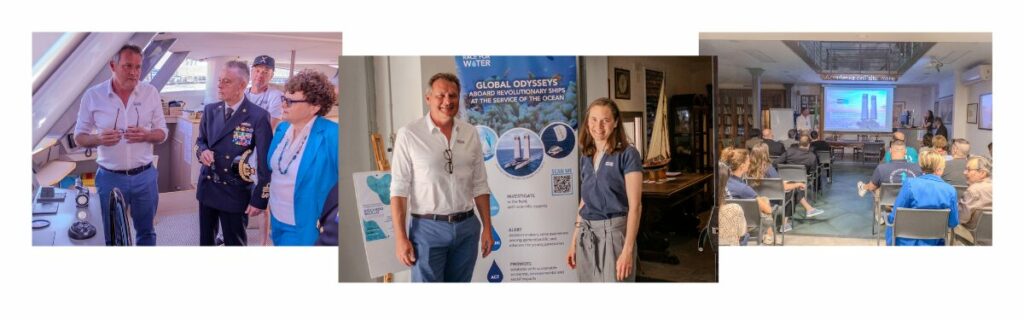
Camille, my boss and incidentally the operations director, had promised us a busy day, and she wasn't lying. It all began with the visit of the Admiral and his entourage of uniformed sailors. Not too complicated for him, since his quarters are located just a few dozen meters somewhere in the long red-brick building adjacent to our ship. On the quay, very ceremonial and considerably emotional—it's not every day one gets to shake hands with the highest representative of the transalpine naval forces—our Commodore and Captain welcomed the dignitaries with smiles, dressed in full uniform with chests adorned with medals and ribbons attesting to distinguished military and maritime achievements.
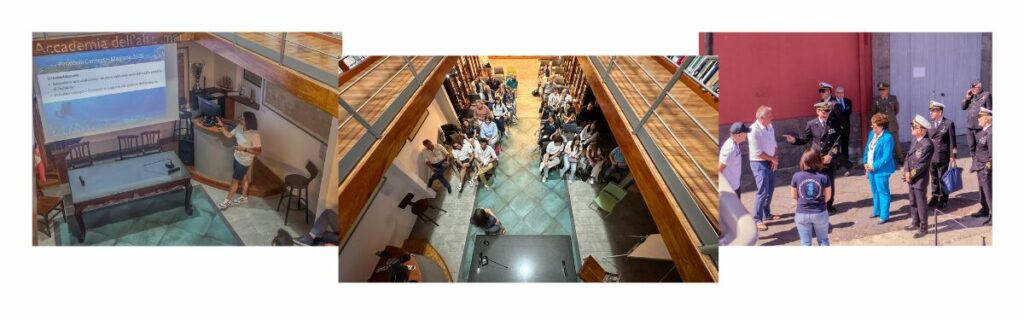 The visit of the MODX 70 continued with an explanation of its swan wing mechanism, the starboard one proudly raised, swaying gracefully in the light breeze, and especially its operation without fossil fuels, which could interest the Squadra Azura Marittima during these turbulent times generated by Mr. Trump over there near Ormuz! Then arrived a wonderful crowd of exuberant and friendly Neapolitan children who marveled with insatiable curiosity at the peculiarities of our incredible boat. Followed by the local press... My! It's already almost noon, and we are expected promptly at the High Sea Academy of the Naval League, a beautiful venue, for a first conference intended for local institutions. From my perch on the loggia, I counted carefully: speakers appeared in order—Lega Navale, Italian Navy, Race for Water Foundation, GIS Posidonie, Stazione Anton Dohrn, Campania Region, Municipality of Naples, and the French Consulate in Italy. Phew, I didn't forget anyone!!!
This presentation was followed by another, public this time, then further boat visits, before we could consider our departure for Toulon later in the day, via Ischia, to drop off our lovely Italian divers and their serious diving tanks on their beloved island. Sniff! Why, this very evening, when Saturday was supposed to be a rest day with guided city tours, pizza tasting, and departure Sunday morning, after thanking the military for their friendly and benevolent welcome? Simply because of those darn weather files predicting a barometric trough (not the Poitevin kind!) across the entire Mediterranean section between Naples and Toulon. And for once, they all agree. So be it. 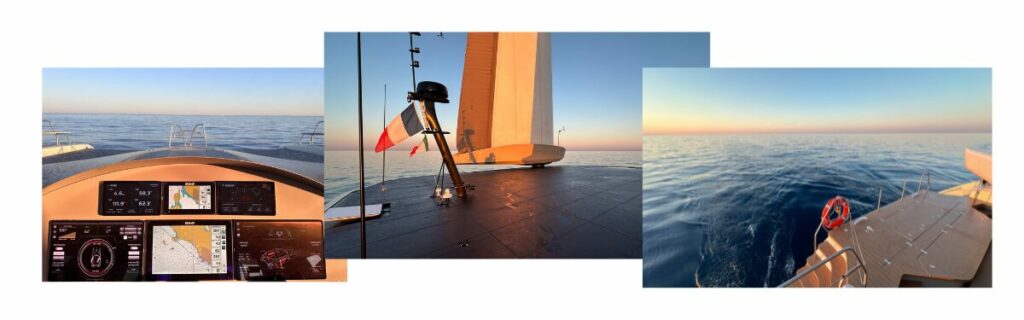 After some unexpected incidents—without them, navigation would be nothing but a long quiet river—the captain cracking his head on the door frame and turning the kitchen sink into a display worthy of the Sanzot butcher shop (see the adventures of Tintin and Snowy), then one of our wings acting up, extending our stop in Ischia by a few hours, here we are this beautiful Mother's Day Sunday at sea (which works out well), diligently avoiding the treacherous calms of the Tyrrhenian and Ligurian seas (a bit of geography never hurts) and arriving on time, safely, in Toulon, the final stop, for our last public meetings of this beautiful Franco-Italian mission.