Posidonia Connect: A Project for Climate Resilience of the Mediterranean and Its Inhabitants
Posidonia Connect is part of the Ocean and Climate Odyssey, a global initiative aimed at understanding and raising awareness of the interdependencies between ocean, climate, and biodiversity. Carried out jointly by the Race for Water Foundation and GIS Posidonie, the project spans several missions aboard the zero-emission catamaran MOX70 "Ganany" until 2030.
The main objective is to harmonize monitoring and better protect seagrass meadows across the Mediterranean basin. Posidonia constitutes a marine habitat of community interest and plays an essential role in climate regulation thanks to its ability to capture and store carbon. Its preservation is therefore strategic for the region's climate resilience.
This project brings together researchers, managers of marine protected areas, public institutions, NGOs, and economic actors from several countries to conduct a shared diagnosis of the health status of this marine seagrass, harmonize evaluation methods according to an ecosystem-based approach called EBQI (Ecosystem-Based Quality Index), and mobilize local actors around concrete solutions for its conservation.
The project is accompanied by outreach work among various audiences to highlight the importance of preserving these blue carbon sinks, key ecosystems for our climate resilience.
Italy Mission 2026
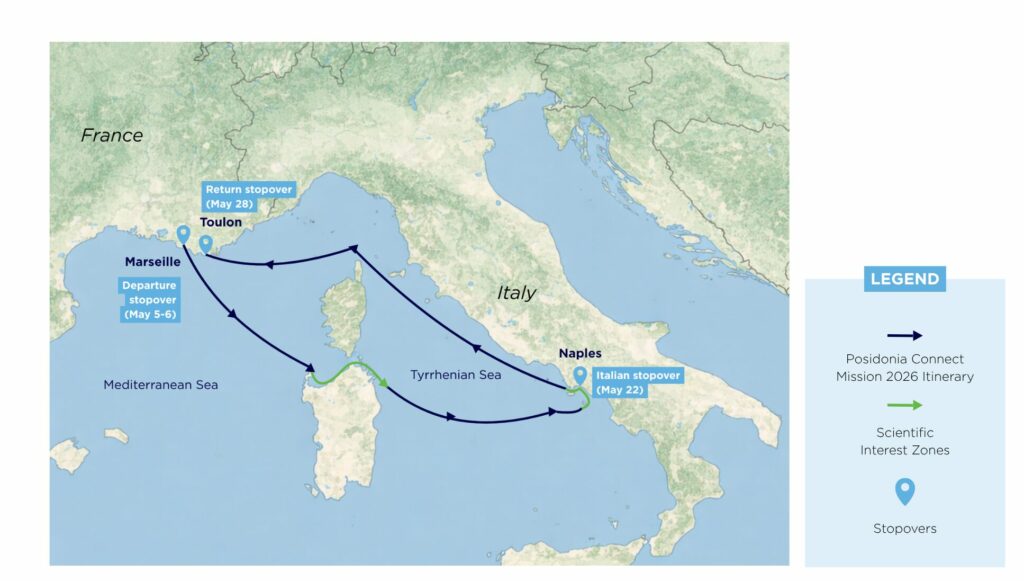
The Italy Mission took place from May 5 to 28, 2026. It constitutes the first pilot stage of the Posidonia Connect project. The team sailed between Marseille, Sardinia, the Gulf of Naples, and Toulon, exploring ten sites distributed across five marine protected areas.
Scientific partners.
Le GIS Posidonie (Aix-Marseille)

GIS Posidonie is a Scientific Interest Group established in 1982 at the initiative of the French Ministry of the Environment and Port-Cros National Park, under the French 1901 non-profit association status. Under an agreement with Aix-Marseille University, its headquarters and permanent team are hosted in facilities provided by the Institut Pythéas at the MIO (Mediterranean Institute of Oceanography).
Two research engineers embarked on the Italy Mission: Bruno Belloni & Patrick Astruch.
Universita degli studi di Sassari (Sardaigne)
The University of Sassari, located in northern Sardinia, hosts recognized expertise in the study of the ecology and restoration of
Posidonia oceanica seagrass beds. Two researchers will join the expedition team during its passage to collect data on Posidonia oceanica around the marine protected areas of Asinara, Capo Testa, and/or Tavolara inside partially and general protected zones.
Two researchers joined the expedition to sample sectors of the Asinara, Capo Testa, and Tavolara marine protected areas: Alessia Crobu and Arianna Pansini.
La Stazione Zoologica Anton Dohrn (Naples)
The Stazione Zoologica Anton Dohrn, founded in 1872, is a world-renowned marine biology research institute, founded in 1872 and dedicated to the study of biodiversity, ecology, and fundamental processes of marine organisms. Its Posidonia oceanica research team actively works to understand the dynamics, resilience, and restoration of these essential Mediterranean ecosystems, combining ecology, molecular biology, and innovative restoration approaches.
Two researchers will join the expedition during their stay in the Gulf of Naples and surrounding.
Four researchers participated in the expedition in the Gulf of Naples: Núria Teixeido, Antonia Chiarore, Emanuele Somma, and Alice Morasole.
Why a First Mission in Italy?
Italy hosts nearly 20% of the total Mediterranean seagrass area. Their regression was documented as early as the 1990s, primarily driven by intensive coastal urbanization, land-
based pollution, and chaotic anchoring. Awareness has led to a progressive strengthening of the legal framework:
1990s–2000s: Integration into the Natura 2000 network (Habitats Directive 92/43/EEC) and designation as Specially Protected Areas of Mediterranean Importance (SPAMI) under the
Barcelona Convention.
2010–2020: Implementation of the Marine Strategy Framework Directive (MSFD), obliging Italy to achieve a "Good Environmental Status" for marine ecosystems.
2024–2025: Adoption of national and regional action plans (e.g., Piano d'Azione per la Conservazione della Vegetazione Marina) and funding for major European projects (LIFE)
specifically targeting restoration and anchoring management.
Within the national framework, two emblematic zones illustrate this trajectory: In Sardinia, the creation of Marine protected Areas (MPAs) in the 1990s (Asinara and Tavolara in 1997) helped slow degradation, transforming these sites into "living laboratories" where citizen science (Tavolaralab) now complements institutional monitoring. In the Gulf of Naples, the response came later but was structural: facing historical degradation linked to dense coastal urbanization, industrialization, and mass tourism, the region established a recognized network of MPAs (Punta Campanella, Gaiola Underwater Park, Regno di Nettuno, Baia Underwater Archaeological Park). These zones now serve as benchmarks for studying resilience against climate stressors (Ischia) and anthropogenic pressures.
Scientific Program and EBQI Protocol
The EBQI protocol (Ecosystem-Based Quality Index), developed by the Mediterranean Institute of Oceanology (MIO), occupies a central place in this mission. Initially deployed in French waters by GIS Posidonie, this holistic indicator represents a major innovation for assessing the health of marine ecosystems.
Unlike traditional approaches that focus solely on the condition of the plant, the EBQI assesses the health of the entire associated ecosystem. It integrates ten different functional compartments: vitality and plant structure (density of leaf bundles, coverage), filter-feeders/suspensivores, detritivores, herbivores, fish assemblages, and piscivorous seabirds.
This approach meets the requirements of European directives MSFD and FFHD, as well as the Barcelona Convention. The Italian mission allows refining the protocol's application in new ecological contexts. The more oligotrophic waters and higher temperatures of Sardinia, combined with the contrasting conditions of the Gulf of Naples, offer unprecedented scenarios for examining the indicator's robustness.
Beyond scientific testing, this mission marks an important step in skills transfer between French and Italian researchers. It fosters strengthened collaboration allowing adaptation and improvement of the EBQI considering each region's biogeographic specificities. Active knowledge sharing builds on the expertise and data already acquired by GIS Posidonie in France, now being leveraged for method harmonization at the Mediterranean scale. In return, the in-depth field knowledge of Italian scientists, acquired over decades of local studies, considerably enriches result interpretation and allows protocols to be adjusted to Italian ecological realities.
Definitive transferability of the EBQI to the entire Mediterranean basin will require complementary tests in other regions with varied environmental conditions. This is precisely the ambition of future missions planned until 2030.
Sites Explored
The scientific team selected sites with distinct environmental conditions to test the EBQI's robustness.
In Sardinia (5 sites): the Asinara, Capo Testa, and Tavolara MPAs. These sites offer environments with more oligotrophic waters and higher average temperatures than the French coast. These parameters shape specific biological communities in terms of abundance and species.
In the Gulf of Naples (5 sites): the Regno di Nettuno, Punta Campanella, and Bacoli MPAs. The exceptional diversity of environmental conditions allows examination of protocol sensitivity to combined stresses. Ischia presents natural CO₂ emissions with morphotypes adapted to acidification. Capri and Sorrente suffer intense tourist pressures. Bacoli ranks among the most degraded sites in the gulf, ideal for evaluating EBQI on heavily impacted habitats.
Initial Findings and Observations
While complete data analyses still need to be conducted to establish definitive results, preliminary field observations reveal a shared conclusion: despite their protected status, a number of visited Posidonia seagrass beds bear the scars of intense human pressure.
Even within marine protected areas, most sites exposed to high tourist and recreational boating traffic display visible signs of degradation. Where regulatory measures are absent or too recent, the impact of anchoring and visitation is visible and sometimes spectacular.
These investigations have benefited from valuable feedback useful for improving common protocols. They highlight the urgency of generalizing adapted management measures such as developing ecological mooring zones (EMZs), coupled with enhanced surveillance and active awareness-raising among boaters and professionals in the nautical sector.
Citizen Mobilization and Outreach in the Mediterranean
In Marseille, Ischia, Naples, and Toulon, the MODX70 became a meeting place for students, scientists, media, and decision-makers. More than 190 students discovered posidonia, ocean-climate interdependencies, and innovations related to sustainable navigation.
Public conferences made research accessible to everyone. At the Naples Naval League, scientists, local authorities, the Italian Navy, and the Campania Region met to discuss the issues of ecosystem monitoring and reinforced protection of Posidonia.
Educational pathways for school students were organized in collaboration with organizations like La Fresque Océane and Ocean Academy. Interactive workshops explored the close links between ocean, climate, and biodiversity, and helped better understand the complex mechanisms related to Mediterranean preservation.
Perspectives and Next Steps
Italy was only the first step. The Posidonia Connect project aims to cover a large portion of the Mediterranean basin by 2030: Balearic Islands, Alboran Sea, Adriatic, Ionian Sea, Aegean Sea, Levantine Basin.
These future missions will allow testing the EBQI in yet different conditions and confirming its transferability at the basin scale. This ambition requires new funding. The Race for Water Foundation calls on public and private actors to support these missions and transform field observations into large-scale management solutions.
The Italy Mission proved that the success of the Posidonia Connect project does not rely solely on the quality of collected data, but on the ability to unite citizens, scientists, managers, and decision-makers around a shared vision for the Mediterranean.
Thank You to Our Partners
This wonderful adventure would be impossible without the exceptional mobilization of all those who accompany us.
Our thanks go first to our technical partners, Océan Développement and Aeroforce, for the design and performance of this revolutionary vessel, as well as the entire crew of the MODX 70 "Ganany": Captain Arnaud Wimille, sailors Marion Eid and Caroline Pottier, and engineers Jean-Marc Normant and Martin Gavériaux.
To the scientific teams: Bruno Belloni and Patrick Astruch from GIS Posidonie, as well as Arianna Pansini and Alessia Crobu from the Università degli Studi di Sassari, Núria Teixeira, Antonia Chiarore, Emanuele Somma, Alice Morasole, and their many colleagues from the Stazione Zoologica Anton Dohrn who mobilized.
To the volunteers from La Fresque Océane and Ocean Academy for the rich and dynamic animations during our educational pathways.
To Marie Treibert for bringing the mission to life on social media from Sardinia to Naples, and to Eric Loizeau for sharing every moment of the expedition with such talent and humor.
Finally, thank you to the port partners who welcomed us under the best conditions: the Municipality of Marseille and the Old Port, as well as the ports of Porto Torres, Ischia, and Toulon Plaisance, and the Italian Navy in Naples.
Thank you all for believing in our project and being part of this collective adventure.