 MONDAY, MAY 4TH
Camille (our expedition coordinator if you didn't know) and I board our proud boat at nightfall, peacefully moored at a pontoon in the Frioul marina. Since our arrival in Marseille, it's been raining cats and dogs, reminding us with a hint of humor of our beloved Brittany. Mind you, the gangway is as slippery as the platforms at St Charles train station! We mustn't fall over, burdened as we are with our bulky and heavy luggage.
With the delightful sound of rain falling, the crew tucked away in the spacious cabin doesn't even hear us arrive. The gangway isn't installed and boarding by arm strength proves almost perilous. Once safe and sound inside, we find the invigorating warmth and a certain serenity, welcomed benevolently by the three crew members: Marion the steward, Caroline the deckhand, and finally Arnaud the captain. Solidly installed in her kitchen that opens directly onto the cabin, Marion is busy behind her electric plate—you can no longer speak of stoves here—and finds time to offer us a welcome drink that we happily share with the crew. I commit my first blunder destined to test Caroline's humor by inadvertently pouring a stream of my beer into her glass of white wine! Her slightly strained smile reassures me! The meal is delicious and so far everything goes well! The evening continues under happy auspices since I find the cozy bunk in my no less cozy cabin. Meeting set for tomorrow morning at seven o'clock to cast off in the direction of Marseille.
TUESDAY, MAY 5TH
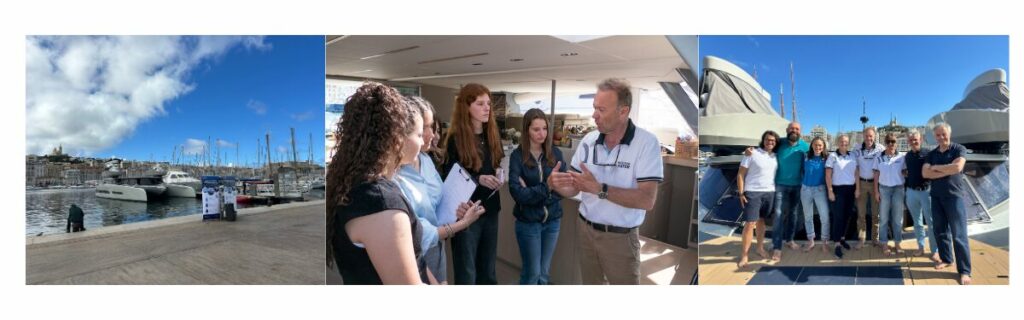
 Stopover in Marseille!
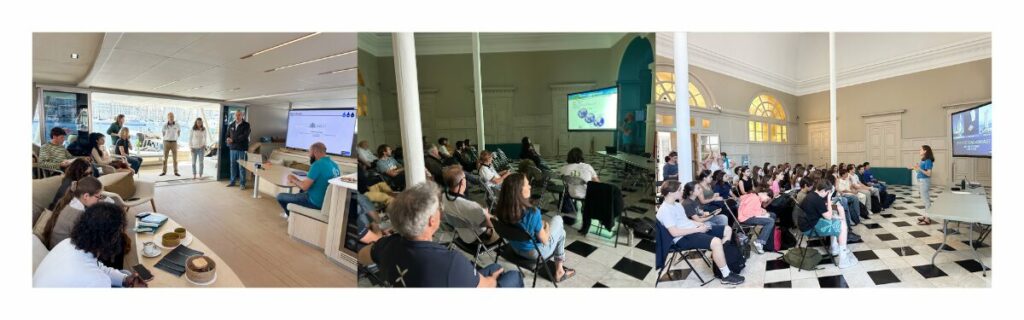
Tuesday, May 5th early morning, we enter the Marseille channel to access our anchorage, after crossing the Ultim trimaran Actual in the middle of a PR tour. They gave up their quay spot in the Old Port right in front of City Hall! Wow! One couldn't dream of a better location for our glorious MODX 70. Even Marcel Pagnol and his famous Marius would have died of jealousy! This ideal place will therefore serve as a meeting point for journalists and school children during these two days of stopover marking the beginning of our Posidonia Connect mission. By the way, Bruno Belloni and Patrick Astruch, both biologist engineers and experienced divers, pillars of the GIS Posidonie in charge of the entire scientific program, have joined us to explain to the public, aboard and in the conference room, the importance of protecting these endemic Mediterranean seagrass meadows. The crew also takes the opportunity to give tours of the boat and provide all necessary technical explanations for understanding the various revolutionary systems on board, including the two inflatable wings that allow the sail propulsion of this boat completely freed from all fossil energy. Four groups of students aged 14 to 18 also had the chance to discover the boat and its crew. To complement this educational journey, Sandrine Zaegel from the Océan Academy association prepared a fantastic quiz for them to learn more about Posidonia meadows. Tomorrow we'll set out to sea at the mercy of wind and sun heading for Sardinia. With the Captain we're looking at the weather files which for now agree to predict broad Mediterranean calms! But we'll see because, as everyone knows, weather isn't a totally exact science! In the meantime, we still have to attend tonight in a bar in the Old Port the football match between Bayern and PSG, a real galéjade as the Marseillais like to say!
THURSDAY, MAY 7TH
At eight thirty exactly Plic and Ploc (those are the nicknames we gave respectively to Bruno and Patrick, our two diver-researchers) embark on our pontoon with their imposing luggage. Our friends certainly don't travel light! I count 8 large compressed air bottles and 6 smaller ones containing oxygen intended for closed-circuit diving, which Patrick confirms with a smile, plus three complete diving suits and their regulators. Not to mention the "small equipment," that is several pairs of fins, neoprene wetsuits, masks and snorkels, lead belt, buoys... I think I haven't forgotten anything! They of course have their toiletries and toothbrushes, plus some small personal items since they'll stay aboard until the end of our mission. All this is piled on the aft deck under the rather worried eye of our captain who frowning wonders where he'll manage to fit all this mess! Knowing that our Italian diver friends who will join us in Sardinia will also embark with their own equipment. Patrick reassures me: "They'll be lighter than us!" I suppose he means their equipment !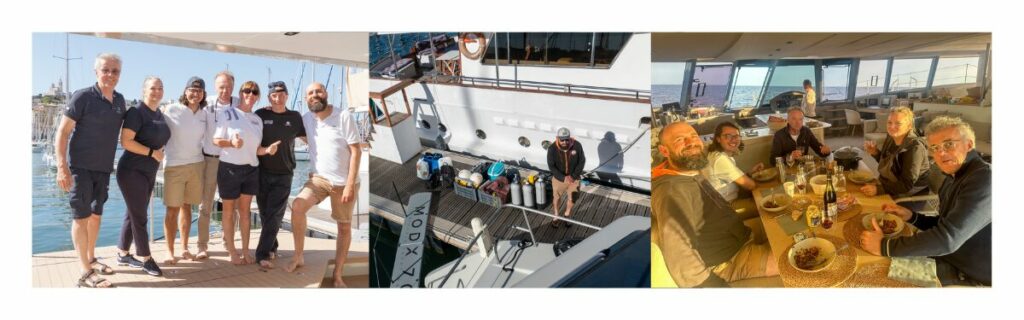
Finally we leave. The sea before us is Mediterranean blue, a light northerly zephyr is blowing, unexpected, which allows us to consider sailing under our wing sails to the great pleasure of the crew. For the crossing to Porto Torres (North Sardinia), we're accompanied by Jean-Marc Normant, engineer by trade, former offshore racer and present on all boats of the Race For Water foundation. He particularly watches the maneuver of our two inflatable wings that we send up, inflate rather, as soon as we exit the channel. The 170 square meters of immaculate sailcloth raised on their imposing balestrons (a sort of long carbon boom that, mounted on a vertical axis, turns according to wind direction) immediately allow us to make our way silently and smoothly at more than seven knots in the right direction and to envision a comfortable first lunch. So far so good!!!
FRIDAY, MAY 8
Out to sea!
After a very calm night, here we are gathered around Adrena (our IT specialist) reviewing the various route plans and weather reports, trying to determine our arrival date and time—ETA, in our seafaring language. For once, they all agree (our reports) that we’ll have light winds all the way to our destination. Our captain agrees with them that our Italian friends are likely to be waiting on the dock! That’s out of the question, so we take turns steering our MODX 70 as best we can, with our two sails fully unfurled and, at times, the help of our two magically silent electric motors. Seated comfortably at the end of the windward float—a safer spot, as the thoughtful architect has placed a comfortable bench there—I gaze out at the sea, a pleasure as infinite as the horizon that surrounds us on all sides. Today, it is gray and resembles more the sea found off the coast of Newfoundland in the northern North Atlantic than here near Corsica and Sardinia. It is not very busy either. So far, we’ve only come across a German container ship heading at a slow pace toward Gibraltar, probably, and also a sailboat sailing alone on a course opposite ours.
A little while ago, a tiny bird—it looked like a finch—stopped by for a break on board, after circling the boat three times, perhaps to make sure we meant no harm. It’s a long-distance journey for those little wings, from Corsica to the mainland—at least 150 kilometers. I always wonder how they manage to cover such long distances without a steady wind to carry them! For now, perched in balance on a lifeline, it seems to be enjoying a charter trip to Sardinia! “A luxury charter,” jokes Bruno. I look out at the sea. This Mediterranean, flanked by often heavily urbanized coastlines, is considered one of the most polluted in the world! And yet, we don’t see any floating trash; but if we took the time to analyze a good liter of it, we’d discover swarms of plastic micro-debris invisible to the naked eye. I had this revelation during my first expedition with Race For Water on the Mod 70 trimaran alongside Steve Ravussin back in 2015. I often tell this story, which really made an impression on me. We were in the middle of the famous South Pacific “gyre” between Valparaiso and Easter Island, 5,000 km² of open sea, rarely visited since the opening of the Suez Canal. In fact, after sailing 2,000 miles, we had come across only a single cargo ship chugging along in the middle of nowhere and, of course, no floating debris. The wind had died down, and we were moving at a very slow pace across a glassy sea of incredible clarity. We took the opportunity to cast our “manta” net overboard, equipped at one end with a cylindrical metal container designed to collect the equivalent of one liter of seawater. After about half an hour of towing, we hauled it in. Steve unscrewed the lid and asked me, “What do you see inside?” I widened my eyes. “Yeah, stuff moving around… they look like sperm!” “Well, that’s plankton,” he replied, “but wait for the rest.” After several complicated steps on the mini-stove in our tiny kitchen, he returns with a small dish where I can barely make out a multitude of tiny yellow, green, and red dots… “Micro-plastic debris,” he explains, smiling at my bewildered expression! It was then that I realized the importance of our anti-plastic missions and, above all, the need to take action upstream to prevent plastic waste from reaching the oceans, sinking to the bottom, breaking down into a multitude of toxic micro-particles, and inevitably polluting the sea and its inhabitants.
In the evening, the sky finally clears and treats us to a dazzling sunset, worthy of the wildest South Seas! The wind remains light, and the crew blissfully prepares for a calm, peaceful night. Let’s make the most of it! On the Mediterranean Sea, the weather can often be unpredictable—take it from a Breton sailor!